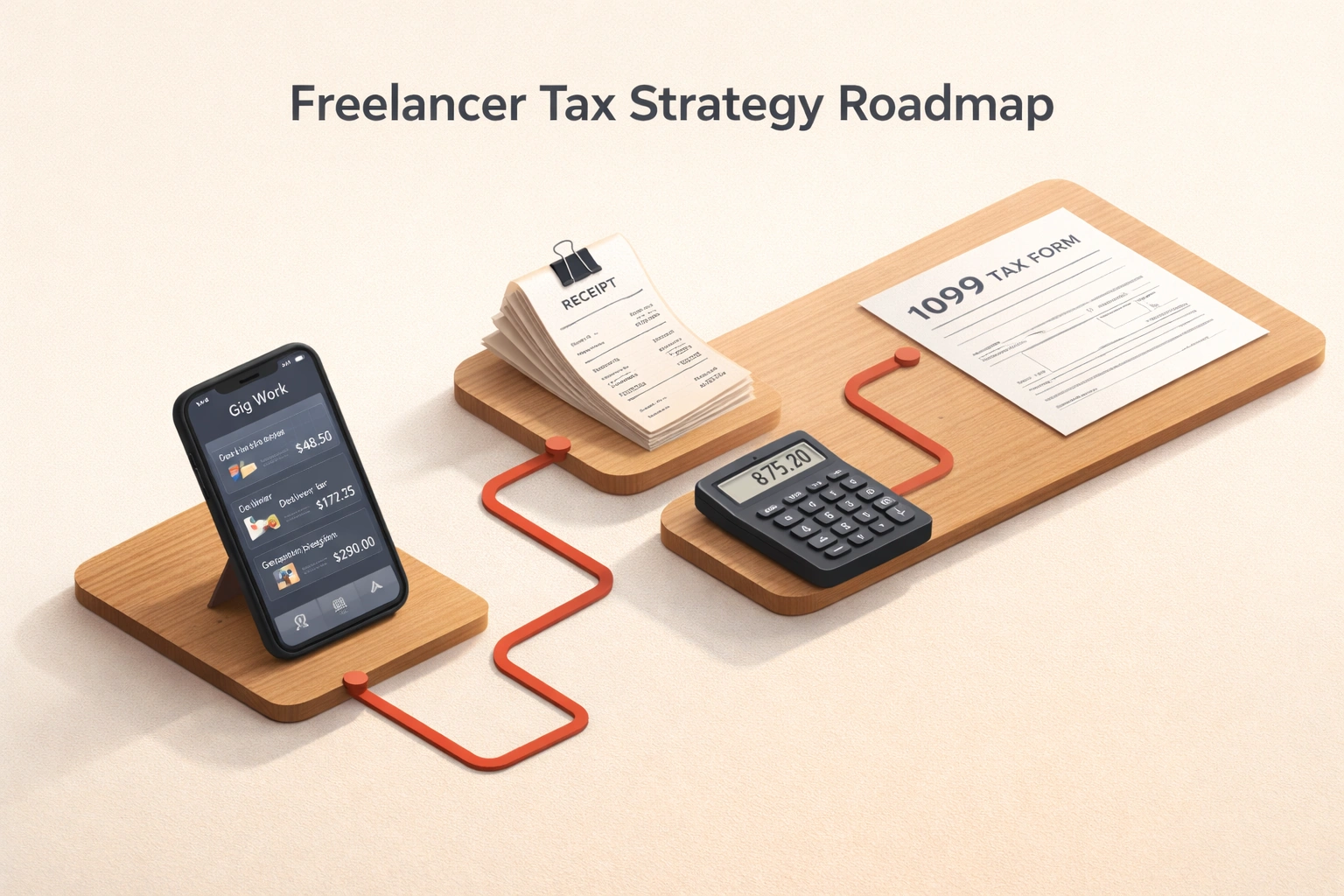
 2026 Freelancer Tax Strategy
Side Hustle Tax Protocol:
Minimize SE Tax & Audit-Proof Your Gig Income
This 2026 freelancer tax strategy hub covers the 15.3% self-employment tax, Schedule C deductions, standard mileage rates, home office simplified methods, and quarterly estimated tax safe harbor rules.
This comprehensive guide explains how to audit your 1099 side hustle income, choose between sole proprietorship and LLC, maximize startup cost write-offs, and legally minimize your IRS tax burden while avoiding audit triggers.
Check your 2026 tax signals:
- Received a 1099-NEC or 1099-K over $600? Yes
- Net profit exceeds the $400 SE tax threshold? Yes
- Using a personal vehicle for gig deliveries? Yes
- Commingling personal and business funds? Yes
Target Outcome
PROFIT PROTECTION Minimize SE Tax + Maximize Schedule C DeductionsSelf-Employment Foundation
3 GuidesEstablish your business identity immediately. Unlike W-2, you pay both halves of FICA. You must prove “Profit Motive” to avoid the Hobby Loss rules. Choosing the right structure (Sole Prop vs LLC) early prevents costly restructuring later.
Deduction Engineering
3 GuidesEvery deduction is a direct 15.3%+ ROI. For most drivers, the standard mileage rate is the efficient choice, but heavy SUVs may benefit from actual expenses. Don’t overlook the $5,000 startup cost election—it’s the only way to recover capital spending like laptops and training before your first revenue.
Compliance & Execution
3 GuidesCommingling funds is the #1 audit trigger. A dedicated business bank account is your first line of defense. Use the 100% Safe Harbor rule to eliminate quarterly penalties. Finally, master Schedule C to categorize expenses correctly and lock in your tax savings.
- Buying a car with HELOC funds (No Deduction)
- Mixing personal/biz funds (Audit Risk)
- Missing Quarterly Deadlines (Penalties)
- Ignoring Startup Cost Write-offs