
The Side Hustle Tax Bible: 1099s, Write-Offs, & LLCs
Your side hustle income is not “free money.” To the IRS, you are now a business owner. This means you face a new 15.3% tax, but you also gain the superpower of “Deductions.” This roadmap turns your gig into a tax-efficient machine.
⚡ 30-Second Summary
- The Shock: 1099 income is taxed higher due to “Self-Employment Tax” (15.3%). You must pay both employer and employee shares.
- The Shield: You only pay tax on Net Profit. Mileage, home office, and even your phone bill can be deducted.
- The Trap: If you don’t pay quarterly taxes or mix personal funds, you invite penalties and audits.
01. The 1099 Shock: Why Your Bill Is So High
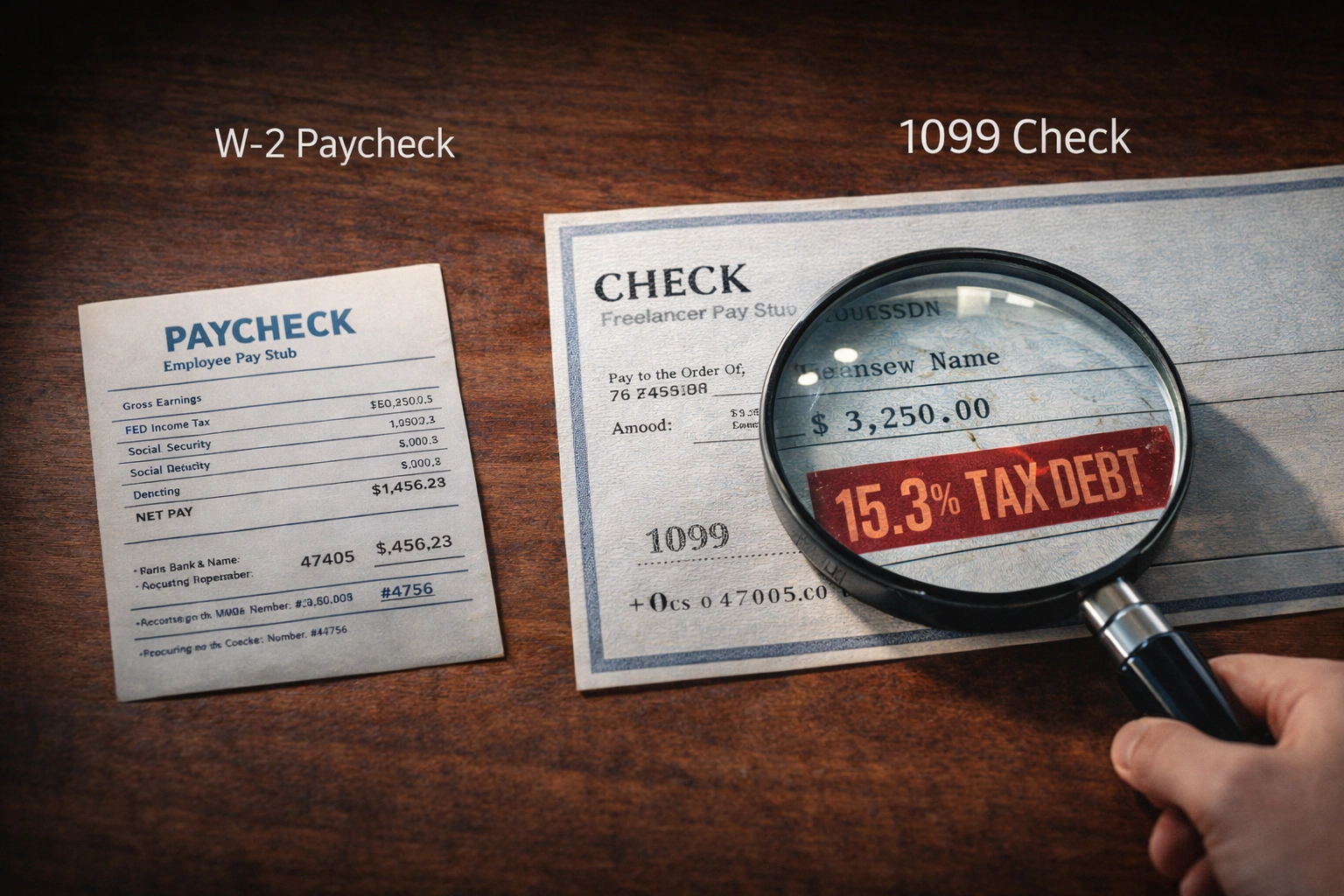
When you are an employee (W-2), your boss pays half (7.65%) of your Social Security and Medicare taxes. When you are a freelancer (1099), you are the boss. You must pay both halves. This 15.3% “Self-Employment Tax” hits you before regular income tax.
📊 The $1,000 Income Comparison
💡 The “Safe Harbor” Rule (How to Avoid Penalties)
The IRS penalizes you if you owe >$1,000 at year-end. To avoid this penalty, pay Quarterly Estimated Taxes equal to:
- Option A: 90% of your current year’s tax bill (hard to guess).
- Option B: 100% of your previous year’s total tax (Safe Harbor).
02. The Shield: Deduct Everything (Legally)
The only way to fight the 15.3% tax is to lower your “Net Profit.” You do this by deducting legitimate business expenses. Most people miss the hidden ones.
Standard Mileage (2026)
- Rate: ~67¢ per business mile.
- Includes: Gas, Insurance, Repairs, Depreciation.
- Best For: DoorDash/Uber drivers with average cars.
Actual Expenses
- Rate: Real cost (Receipts required).
- Includes: Gas receipts, Oil changes, Tires.
- Best For: Heavy SUVs > 6,000 lbs (Bonus Depreciation).
🔍 Commonly Missed Deductions
- Phone & Internet: You can deduct the business percentage. (e.g., If you use your phone 50% for work, deduct 50% of the bill).
- Software: Adobe Creative Cloud, ChatGPT Plus, Microsoft 365.
- Start-up Costs: Up to $5,000 in costs (LLC filing, equipment) incurred before you launched.
- Business Meals: 50% deductible if discussing business with a client (keep the receipt!).
Home Office Rule: Renters can deduct $5 per sq. ft. (Simplified Method). If your desk takes up 100 sq. ft., that’s a $500 deduction. Warning: The space must be used exclusively for work (no TV, no bed).
03. Do You Need an LLC?
A common beginner mistake is rushing to pay $800+ for an LLC. An LLC is for Legal Protection, not tax savings.
 Figure 2: An LLC shields your personal assets (house/car) from business lawsuits.
The “Piercing the Veil” Risk: If you have an LLC but use your personal checking account for business expenses, a judge can dissolve your LLC protection. You must have a separate business bank account.
⚠️ Critical: The Operating Agreement
Even a single-member LLC needs an Operating Agreement. This internal document proves you are running a legitimate business, not a hobby. Banks often require it to open a business account.
04. The Danger Zone: Hobby Rules
If you keep claiming losses to lower your W-2 taxes, the IRS may reclassify your gig as a “Hobby.” Result: All deductions are disallowed retroactively.
The 3-Year Rule: The IRS generally presumes you are a business if you show a profit in 3 out of the last 5 years. If you are not profitable, you must prove “Profit Intent” (e.g., changing strategy, consulting experts).
05. Execution Roadmap
Execution Rule: Documentation beats conversation. If it’s not written down (receipt/log), it didn’t happen.
The Side Hustle Protocol
Step 1. Separation (Day 1)
Open a separate checking account (e.g., Chase Business, Novo, Bluevine). All gig income goes in; all gig expenses come out.
Step 2. Audit-Proof Tracking
Every receipt must show 4 things: Date, Amount, Vendor, and Business Purpose. Writing “Lunch” is not enough; write “Lunch with Client X to discuss contract.”
Step 3. The 30% Rule (Monthly)
Transfer 30% of your Profit (Income – Expenses) to a high-yield savings account for tax season. Do not touch this money.
Step 4. Filing (Yearly)
File Schedule C with your Form 1040. If net earnings are > $400, you must file.