Investing Made Easy: what is a target
date fund for 2026?
Managing a retirement portfolio over 40 years requires constant, unemotional rebalancing. As you age, your capital must transition from aggressive growth (stocks) to capital preservation (bonds). Human psychology, however, makes investors terrible at this: they buy stocks at the peak out of greed and sell at the bottom out of fear. A Target Date Fund (TDF) completely eliminates this human error. It is a highly sophisticated, institutional mutual fund that automatically adjusts its risk profile based on your projected retirement year. You simply pick the year you plan to turn 65, deposit your capital, and let the algorithm do 100% of the trading. Here is the CPA-verified analytical framework explaining what is a target date fund →, how its internal “Glide Path” math works, and how to spot the hidden fee traps inside your corporate 401(k).
This article is for you if:
✓You want to invest for retirement but have zero desire to research individual stocks
✓You are setting up your 401(k) and see options like “Vanguard Target 2060”
✓You need an automated system that protects your money as you get closer to age 65
RReviewed by BMT Retirement Desk·
Sources: SEC, Vanguard · Informational Guide
THE ALGORITHM
Glide Path
The formula that auto-shifts stocks to bonds
Institutional Analytics · Full sources → SEC 06
IDEAL FEE
< 0.15%
Target expense ratio for index TDFs
MANAGEMENT
Zero Effort
The ultimate “set and forget” asset
Key Execution Facts
1Pick the fund nearest to your retirement year.
2Never mix target date funds with other stocks.
3Avoid funds with expense ratios above 0.50%.
Disclaimer: This article explains the mechanics of Target Date Funds (TDFs) based on 2026 market structures. Not all TDFs are created equal. Some utilize low-cost passive index funds, while others use expensive actively managed funds. Always check the fund’s specific “Expense Ratio” before allocating your capital.
SEC 02PROBLEM— The Rebalancing Failure
SECTION 02 — THE PROBLEM
You Will Forget to Protect Your Capital
The standard lifecycle of a DIY investor is inherently flawed. In their 30s, they put 100% of their money into aggressive tech stocks. This is mathematically correct when you have 30 years to recover from a crash. However, the crisis occurs when they turn 62. They get busy with their careers and families, and they forget to manually sell their stocks and buy stable bonds. When a severe market crash hits the year before they retire, their portfolio drops by 40%, completely destroying their ability to stop working. They failed to adjust their risk.
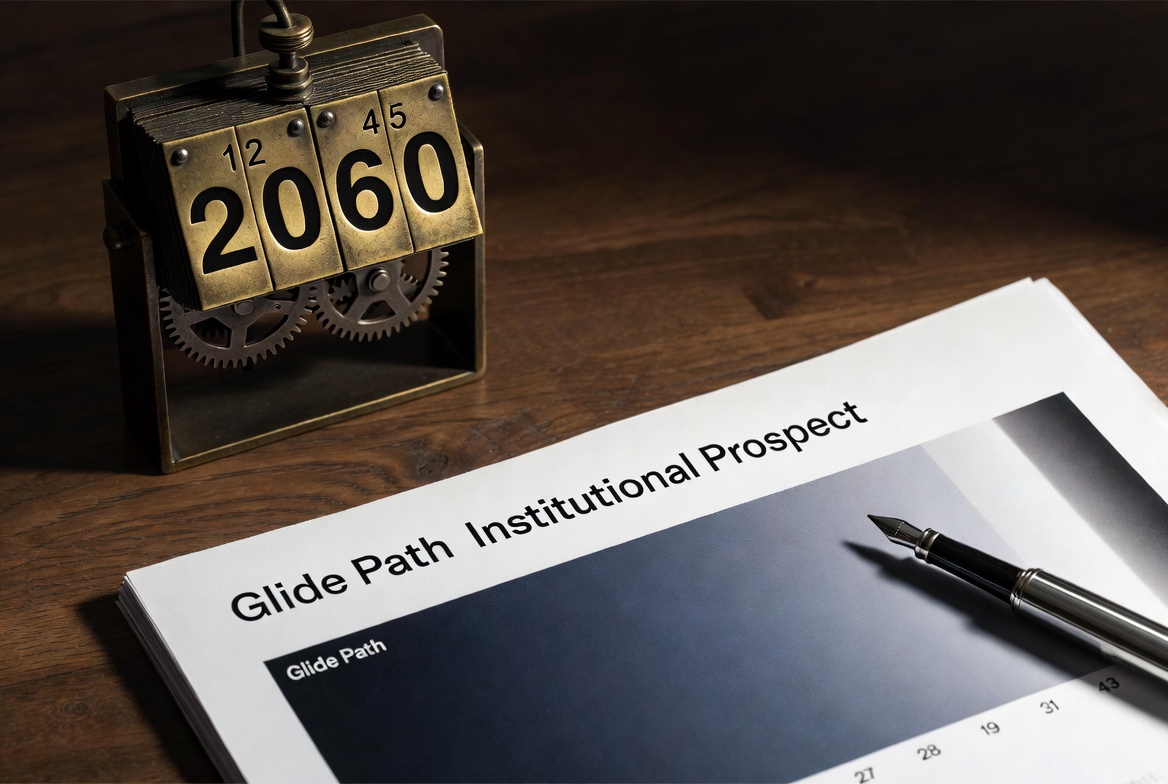
A Target Date Fund solves this via a mechanism called the Glide Path. If you buy a “Target 2060 Fund,” the fund managers know you are decades away from retiring. They automatically invest 90% of your money in global stocks. As the year 2060 approaches, the algorithm smoothly and automatically sells off the volatile stocks and buys secure bonds and Treasury bills. By the time you reach 65, the portfolio has “glided” into a highly defensive stance. You get the growth when you are young, and the protection when you are old, without ever having to log in and press a button.
The DIY Gambler
Forgets to rebalance and stays 100% in stocks at age 64
Loses half their retirement savings during a sudden market crash
Pays high capital gains taxes from constantly buying and selling assets manually
Stresses over daily financial news trying to “time the market”
The TDF Optimizer
Picks a single fund dated for the year they turn 65 and automates deposits
Rides the algorithmic Glide Path into a safe 50/50 bond split before retirement
Never triggers taxable events because the rebalancing happens inside the fund
Checks their account once a year and ignores all short-term market noise
EXECUTION WATCH OUT
The Duplication Trap. A Target Date Fund is designed to be your *entire* portfolio. It already owns the S&P 500, international stocks, and bonds. If you buy a TDF, and then also buy Apple stock and a separate S&P 500 ETF, you are ruining the fund’s mathematical balance by artificially overweighting your portfolio in US large-cap stocks. Pick the TDF, and let it stand alone.
SEC 03EVIDENCE— Data + Sources (E-E-A-T)
SECTION 03 — EVIDENCE & DATA
The Anatomy of the Glide Path
Percentage of portfolio allocated to high-growth stocks
The StrategyDe-risking
Maximum capital retention for the investor
Wealth destroyed by Wall Street management fees
The DangerActive Fees
Source: Vanguard Institutional Target-Date Analytics, Securities and Exchange Commission (SEC)
SEC 04FAQ— Fund Mechanics
SECTION 04 — FAQ
Frequently Asked Questions
The fund does not liquidate, sell off, or close down. It simply reaches its most conservative “landing point” on the glide path (typically around 40% to 50% bonds). It will continue to generate dividends and slight growth, allowing you to safely withdraw your required income throughout your retirement without fear of a sudden market crash wiping you out.
Yes. A TDF is heavily invested in the stock market. In your 30s and 40s, if the S&P 500 drops 20%, your TDF will likely drop by a similar amount. This is intentional. You are accepting short-term volatility in exchange for long-term compound growth. The fund only becomes “safe” from heavy drops when you are in your 60s and it has shifted to bonds.
You must “hack” the date. Do not pick a fund based on your birth year. Pick the fund that aligns with the year you actually plan to stop working. If you are 35 today and plan to FIRE (retire early) in 15 years, you should buy the “Target 2040 Fund,” not the 2055 fund. This forces the algorithm to protect your money earlier.
SEC 05DECISION— If/Then Framework
SECTION 05 — DECISION SUPPORT
The TDF Optimization Matrix
Use this tactical framework to ensure you are deploying capital into a mathematically sound algorithm, avoiding high-fee corporate traps.
Your Situation (IF)Recommendation (THEN)
You want zero involvement in managing your retirement portfolio
You value automation over aggressive micro-management
Put 100% of your IRA or 401(k) contributions into a single Target Date Fund. Do not buy anything else. Let it run.
Your company’s 401(k) TDF has a massive 1.2% “Expense Ratio”
This is an actively managed fund designed to drain your wealth
Decline the TDF. Build a manual portfolio using the cheapest S&P 500 Index Fund offered in the 401(k) to bypass the fee.
You plan to work until 65, but want your portfolio to stay highly aggressive
You are willing to accept severe market drops in your 60s
Pick a fund dated 10 years *past* your retirement (e.g., 2075 instead of 2065). This tricks the algorithm into holding stocks longer.
You already own a TDF, but are also buying random individual tech stocks
You are ruining the fund’s risk algorithm
Stop. If you want to pick stocks, do it in a separate standard brokerage account with “play money,” not your retirement vault.
CPA COMMENT — 80% GUIDE
The only metric you need to verify before buying a TDF is the word “Index.” You want a “Target Date Index Fund,” not a regular Target Date Fund. The “Index” version uses passive algorithms, keeping the fees close to 0.08%. The non-index version uses highly paid human managers and charges 0.75%, which will cost you hundreds of thousands of dollars over 30 years.
Securities and Exchange Commission (SEC) — Investor Bulletin: Target Date Retirement Funds(2026) · investor.gov
2
Vanguard Group — Target-Date Fund Principles and Glide Path Construction(2026) · vanguard.com
Sources are cited for informational purposes. The mention of Vanguard or any specific retirement year fund is for educational illustration and does not constitute a direct buy recommendation. Always review the fund’s prospectus to verify the underlying expense ratio.
The only metric you need to verify before buying a TDF is the word “Index.” You want a “Target Date Index Fund,” not a regular Target Date Fund. The “Index” version uses passive algorithms, keeping the fees close to 0.08%. The non-index version uses highly paid human managers and charges 0.75%, which will cost you hundreds of thousands of dollars over 30 years.