Executive Summary
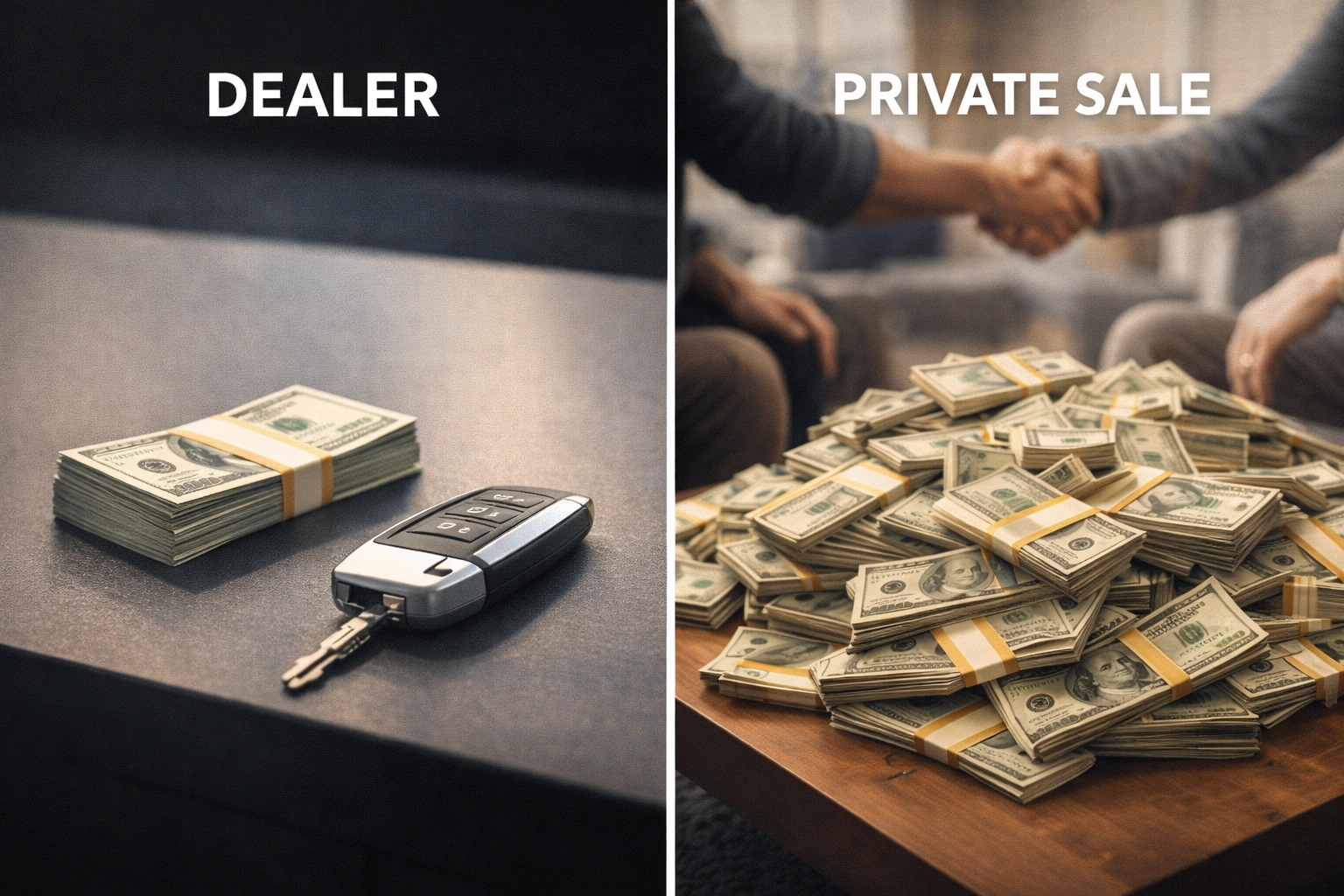
Trading in your car is the most expensive convenience you will ever buy. Dealers pay “wholesale” prices for trade-ins so they can resell them at “retail.” By selling privately or getting an instant cash offer from aggregators like CarMax or Carvana, you can typically pocket 15–25% more cash (often $3,000+) compared to a dealer trade-in offer.
When you trade in your car, you are not “selling” it; you are liquidating it at a discount. The dealer needs to recondition it, market it, and make a profit. That profit margin comes directly out of your equity. While trading in is easy—you toss the keys and sign a paper—that ease often costs you $500 per minute of paperwork.
This guide is your Exit Strategy. Whether you are upgrading or escaping Negative Equity, how you sell your current car determines your budget for the next one.
The “Wholesale” vs. “Retail” Gap
Understanding the numbers is crucial. Let’s assume your car has a market value (Retail) of $20,000.
- Trade-In Offer: The dealer offers $16,000 (Wholesale).
- Private Sale: You list it on Autotrader/Craigslist for $21,000 and settle for $20,000.
In this scenario, trading in costs you $4,500. Is saving 5 hours of work worth $4,500? That’s $900 per hour tax-free.
The “Sales Tax Credit” Myth
Dealers have one valid counter-argument: “But you save on sales tax!” In most states, if you trade in a car, you only pay sales tax on the difference between the new car price and the trade-in value.
| Factor | Scenario A: Trade-In | Scenario B: Private Sale |
|---|---|---|
| New Car Price | $40,000 | $40,000 |
| Your Old Car Value | $16,000 (Trade Offer) | $20,000 (Sold Cash) |
| Taxable Amount | $24,000 ($40k – $16k) | $40,000 (Full Price) |
| Sales Tax (8%) | $1,920 | $3,200 |
| Net Benefit | Saved $1,280 in Tax | Gained $4,000 in Price |
The Verdict: Even after saving $1,280 in taxes, the Private Sale puts you ahead by $2,720 ($4,000 price gain – $1,280 tax loss). Do the math before you accept the tax excuse.
The Middle Ground: “Instant Cash Offers”
If you don’t want the hassle of meeting strangers for a private sale, use the “Aggregator Strategy.” Companies like CarMax, Carvana, and Vroom compete for inventory. Their offers are often higher than a traditional dealer’s trade-in offer but lower than a private sale.
The Leverage Tactic
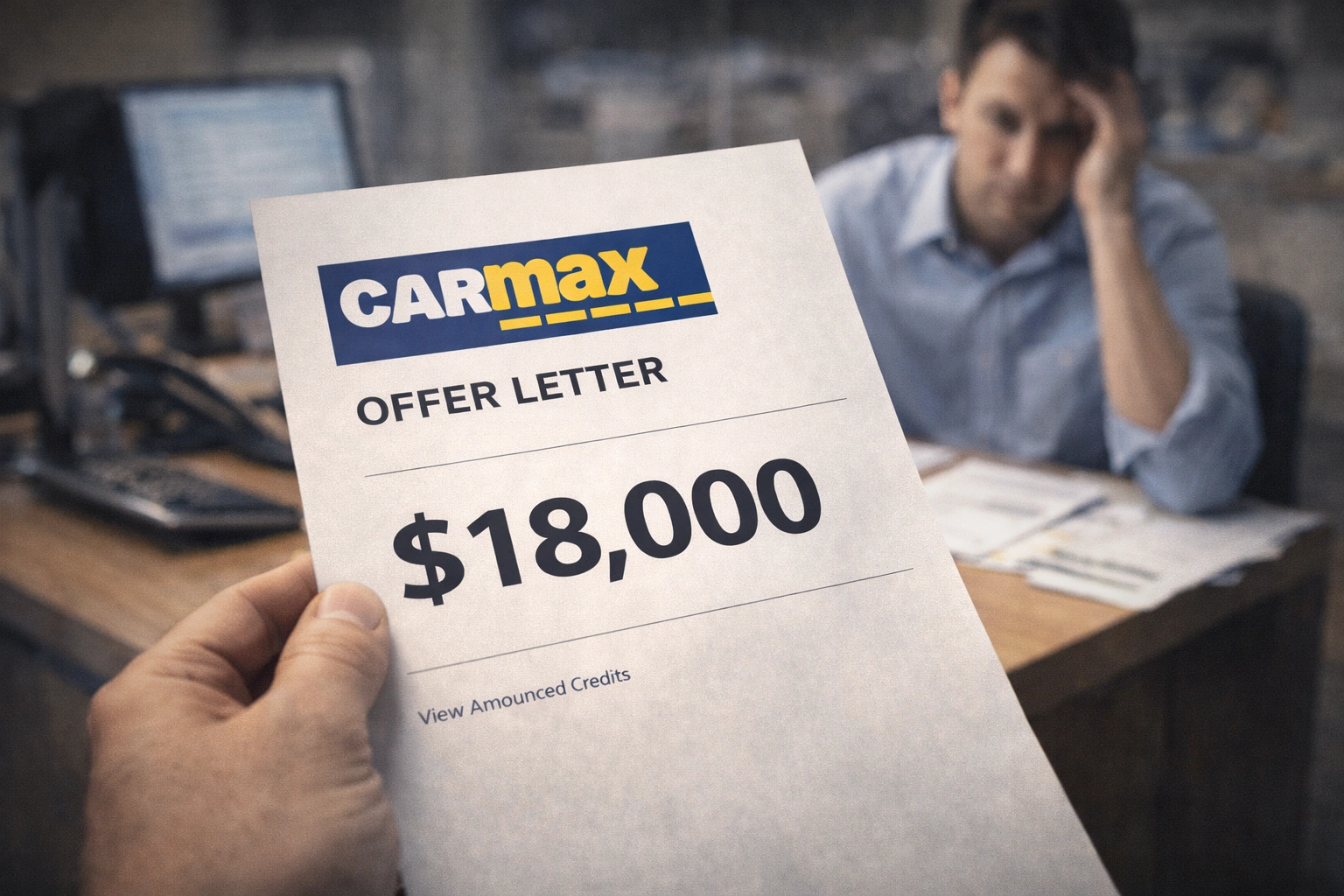
1. Get a written offer from CarMax (valid for 7 days).
2. Take that offer to the dealership.
3. Tell them: “CarMax offered me $18,000. If you match it, I’ll trade it in to get the tax credit. If not, I’ll sell it to them.”
This forces the dealer to step up or lose the trade-in inventory.
How to Sell Privately (Safely)
Selling a car yourself is not as scary as it seems. Follow this protocol:
- Meet in Public: A police station parking lot or your bank lobby is safest.
- Cash or Cashier’s Check Only: Never accept personal checks, PayPal, or “overpayment” scams. Meet at the buyer’s bank to verify the cashier’s check.
- Bill of Sale: Download a generic “Bill of Sale” for your state. Sign it only when cash is in hand.
- Remove Plates: In most states, you keep your license plates. Do not let the buyer drive off with your tags.
Frequently Asked Questions
Is it hard to sell a car with a loan on it?
It adds one step. You and the buyer meet at your bank (or the buyer sends payment to your lender). The lender pays off the loan, gives the title to the buyer, and sends the remaining profit to you. It’s routine for banks.
What if my trade-in offer is higher than CarMax?
Sometimes dealers “over-allow” on a trade-in (offer more than it’s worth) to distract you from the new car’s price. If the trade-in offer seems too good to be true, check if they raised the price of the new car or added hidden fees.
Does KBB Instant Cash Offer work?
Kelley Blue Book (KBB) Instant Cash Offer is essentially a lead generator for local dealers. It is a valid baseline, but often lower than CarMax. Treat it as a “floor” price, not a ceiling.
Should I fix my car before trading it in?
No. Dealers can fix dents and scratches for 20% of what a body shop charges you. Don’t spend $500 to increase the trade value by $200. Detail it (clean it) thoroughly, but don’t repair it.
Conclusion: It’s Your Money, Not Theirs
The dealership sees your trade-in as a second profit center. By trading it in blindly, you are donating your equity to them. Whether you sell privately or force a price match, treating your old car as a separate transaction is the final step in mastering the car buying game.
Series Complete!
You have mastered Smart Spending on Vehicles. From Leasing vs Buying to Affordability Rules, you are now equipped to navigate the auto market without losing your shirt.