Executive Summary
Strategic Banking & Liquidity Defense is the active management of cash reserves to mathematically eliminate institutional fee extraction while maximizing risk-free yield.
The traditional US banking model is highly predatory toward passive consumers. Mega-banks continue to pay near-zero interest on deposits (often 0.01% APY) while actively lending your capital at 7% to 20% rates. Understanding what a High-Yield Savings Account (HYSA) is and executing the transfer of liquid wealth to online institutions is the absolute prerequisite for capital preservation in 2026. Comparing online banks vs traditional banks reveals that avoiding brick-and-mortar overhead instantly eliminates monthly maintenance fees.[1]
Beyond yield starvation, consumers face massive capital leakage through punitive fees. Banks generate billions annually by obscuring the rules around how to avoid overdraft fees. Legally opting out of "overdraft protection" immediately stops this bleed. Simultaneously, relying on cash advance apps acts as a modern payday loan trap, charging hidden "tips" and expedited fees that rival triple-digit APRs.
Advanced liquidity defense requires mastering institutional rules. If you have been blacklisted from the banking system, you must know how to pull and dispute your ChexSystems report under the Fair Credit Reporting Act (FCRA). For high-net-worth individuals, thoroughly understanding FDIC insurance limits prevents catastrophic loss during bank failures.
Strategic Position: Stop subsidizing mega-banks. Build a 3-to-6 month emergency fund, park it in an HYSA or Certificate of Deposit (CD), and automate your finances to completely bypass the behavioral friction of saving.
Structural Background

In the post-ZIRP (Zero Interest Rate Policy) economy, the disparity between what banks charge for debt and what they pay for deposits has reached historic extremes. Consumers who fail to actively manage their cash positioning are heavily penalized.
The 0.01% APY Illusion
Major national banks rely on consumer inertia. They maintain 0.01% Annual Percentage Yields (APY) on savings accounts simply because customers find switching banks tedious. Meanwhile, FDIC-insured online banks routinely offer 4.0% to 5.0% APY. On a $20,000 emergency fund, this is the difference between earning $2 a year versus $1,000 a year, entirely risk-free.[2]
The Shadow Credit Bureau
Unlike FICO scores which measure debt management, ChexSystems measures banking behavior (e.g., unpaid overdrafts, bounced checks). Being flagged in this system effectively exiles a consumer from traditional banking for up to five years, forcing them into predatory check-cashing services. Disputing inaccuracies here is a critical, yet rarely discussed, legal right.
Federal law requires banks to ask you to "opt-in" to overdraft protection for debit card transactions. If you opt-in, the bank lets a $4 coffee transaction clear when you have $2 in your account, and instantly hits you with a $35 Non-Sufficient Funds (NSF) fee. Opting out means the card is simply declined—for free.
Core Drivers
Driver 1: The Liquidity Yield Curve (HYSA vs CD)
Parking cash is a trade-off between liquidity and yield. A High-Yield Savings Account provides 100% liquidity with variable rates that fluctuate with the Federal Reserve. A Certificate of Deposit (CD) locks in a fixed rate for a set term (e.g., 6 or 12 months) but imposes an early withdrawal penalty. Structuring a "CD Ladder" alongside an HYSA ensures you capture high fixed rates while maintaining rolling access to cash.
Driver 2: Institutional Fee Evasion
Traditional banking revenue is heavily subsidized by low-income consumers via monthly maintenance fees, minimum balance penalties, and NSF fees. Transitioning to online-only banks (e.g., Ally, SoFi, Capital One) fundamentally alters this dynamic. These institutions eliminate physical branch overhead, allowing them to abolish minimum balances, refund ATM fees, and abolish overdraft fees entirely. This is an immediate, zero-risk return on capital.
Driver 3: Catastrophic Institutional Risk (FDIC)
The banking crisis of 2023 proved that large institutions can fail over a weekend. FDIC insurance protects up to $250,000 per depositor, per insured bank, per ownership category. High-net-worth households holding cash proceeds from a home sale or business exit must strategically split capital across multiple banking charters or utilize sweep networks (like IntraFi) to legally expand this $250,000 limit into the millions.[3]
Data Deep Dive
Scenario Analysis: The Compound Effect of HYSA Yields
Assumptions: $20,000 Initial Emergency Fund. Adding $500/month. HYSA APY at 4.50% vs Traditional Bank at 0.01%. Note: Interest rates are illustrative and subject to Federal Reserve rate changes.
| Banking Feature | Traditional Mega-Bank | Online HYSA / Checking | Net Consumer Impact |
|---|---|---|---|
| Average APY (Savings) | 0.01% - 0.05% | 4.00% - 5.00%+ | +$1,000/yr per $20k saved |
| Monthly Maintenance Fee | $12 - $15 (unless minimums met) | $0 | +$144/yr Saved |
| Overdraft / NSF Fees | $35 per occurrence | $0 (Declined or Free Transfer) | Zero penalty risk |
| Cash Deposits | Any local branch | Limited (Partner networks only) | Slight inconvenience |
| FDIC Insurance | Up to $250,000 | Up to $250,000 | Identical legal safety |
The "True" Emergency Fund Calculator
Calculate the absolute minimum cash required in a highly liquid HYSA to survive a 3-month job loss.
(Rent/Mortgage) + (Groceries/Utilities) + (Min Debt Payments)
= Monthly Baseline
(Monthly Baseline) × 3 Months
= Minimum HYSA Target
*Note: Exclude retirement contributions, subscriptions, and dining out from the "Bare-Bones" calculation. This fund exists solely to prevent eviction and starvation, not to maintain a luxury lifestyle.
Decision Protocol Matrix
Select your current financial situation to identify the optimal banking execution strategy.
| Profile / Scenario | Recommended Strategy | Rationale & Exceptions |
|---|---|---|
| Paycheck to Paycheck Balance often drops below $100 |
Opt-Out of Overdrafts | Call your bank today and explicitly opt out of "Reg E Overdraft Protection." A declined card is embarrassing; a $35 fee for a $2 coffee is devastating. |
| Holding >$10k Cash Sitting in a Chase/BofA account |
Transfer to Online HYSA | Instantly open an account with Marcus, SoFi, or Ally. Link accounts and transfer. Keep a local checking account only for physical cash deposits if needed. |
| Denied a Bank Account Flagged by ChexSystems |
Second Chance Checking | Request your free ChexSystems report. Dispute errors via certified mail. In the interim, open a "Second Chance Checking" account at a local credit union. |
| Cash-Rich, Risk-Averse Saving for a house down payment |
Short-Term CD Ladder | Lock in 6-month and 9-month CDs to guarantee yield, preventing the bank from lowering your rate if the Fed cuts interest rates. |
Risk Map
Mechanism: Holding $300,000 in a single individual account at one bank. If the bank fails and is put into receivership, the $50,000 above the FDIC limit is legally at risk of permanent loss.
Mechanism: Using "Cash Advance" apps (like Earnin or Dave) to bridge paychecks. While claiming "no interest," they charge mandatory expedited transfer fees and solicit "tips," effectively resulting in 300%+ APRs.[4]
Mechanism: Abandoning an account with a negative balance of $15. The bank reports you to ChexSystems. For the next 5 years, 80% of US banks will automatically deny your application for a checking account.
Mechanism: Locking your entire emergency fund into a 12-month Certificate of Deposit (CD). If you lose your job in month 3, breaking the CD triggers a penalty (usually 60-90 days of interest), negating the yield.
Strategic Playbook
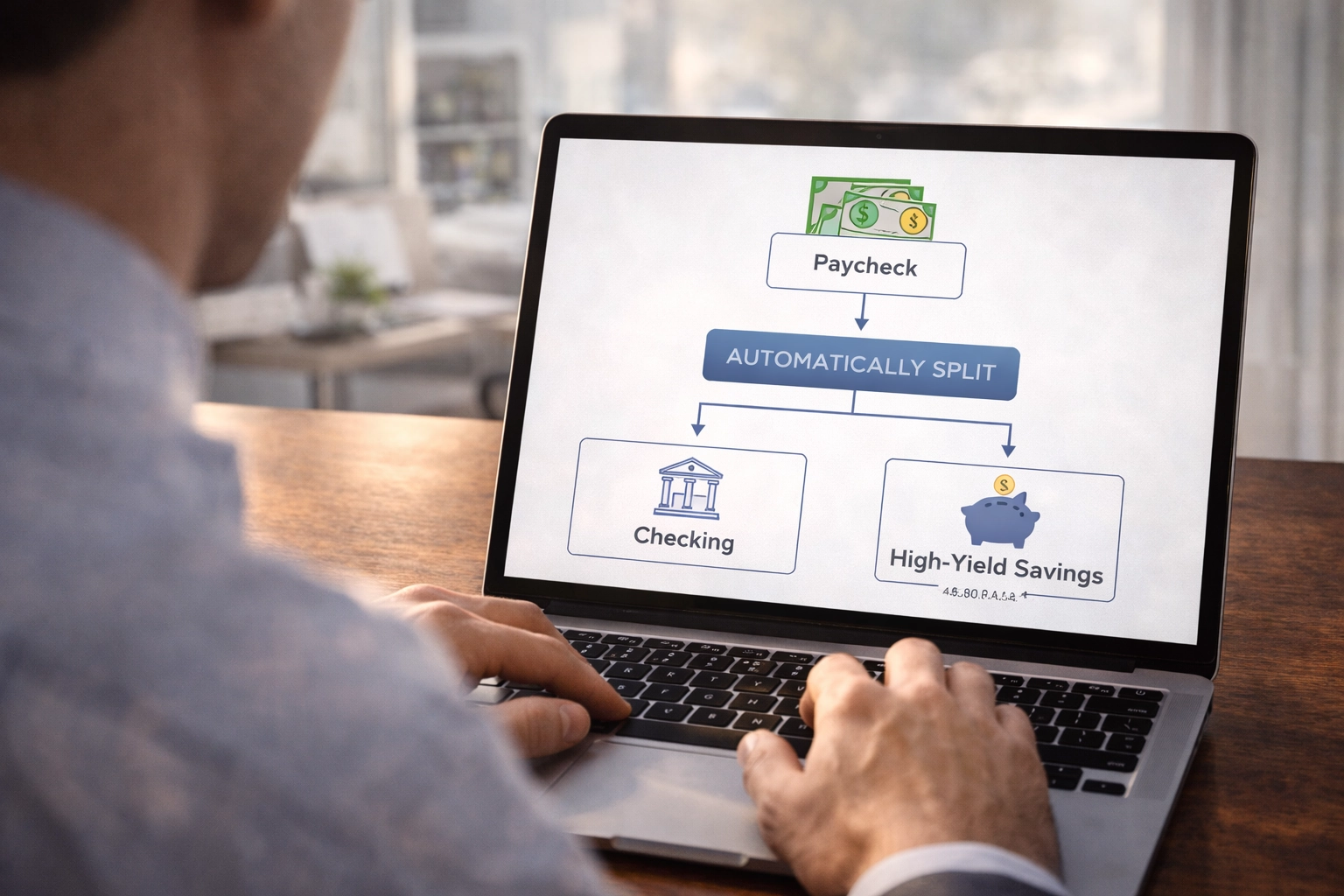
Execution Protocol: The "Set It & Forget It" Banking Architecture
Log into your current bank. Check your APY and review the last 6 months of statements for any maintenance or NSF fees. If APY is below 4.0% or fees exist, immediately open an FDIC-insured Online HYSA (e.g., Marcus, Discover) and a zero-fee online checking account.
Update your payroll portal at work. Split your direct deposit: route 10-20% directly into the newly opened HYSA (untouchable emergency fund), and the remaining 80-90% into your primary checking account for bills and lifestyle.
Inside your HYSA, utilize "Buckets" or "Vaults" (a feature common in online banks) to create Sinking Funds for predictable upcoming expenses (e.g., Car Insurance, Property Taxes). Set auto-pay on all credit cards to pull the statement balance in full every month from checking.
Frequently Asked Questions
An HYSA is exactly like a regular savings account, completely FDIC insured and highly liquid. The only difference is it is typically offered by online-only banks that pass their savings on physical branch costs directly to you in the form of massively higher interest rates (often 100x higher than traditional banks). (Deep dive: HYSA Explained.)
Under Federal Reserve Regulation E, banks cannot charge you overdraft fees on ATM or everyday debit card transactions unless you explicitly "opt-in." Simply call your bank or log into your portal and revoke your consent for "Overdraft Protection." If you lack funds, the card will simply decline. (Read the guide: Avoiding Overdraft Traps.)
They are slightly less predatory but operate on the same mathematical mechanism. While they don't explicitly charge "interest," the combination of monthly subscription fees, required "tips," and instant-transfer fees can equate to a massive APR, keeping users trapped in a paycheck-to-paycheck cycle. (See analysis: Cash Apps vs Payday Loans.)
ChexSystems is a consumer reporting agency that tracks closed checking and savings accounts due to unpaid fees or fraud. Under the FCRA, you are entitled to a free report every 12 months via their website. If you are denied a bank account, this is likely why. (Resolution steps: How to Clear ChexSystems.)
If you anticipate the Federal Reserve will cut interest rates in the coming months, a CD is better because it "locks in" today's high yield for the entire term. If you need absolute liquidity for an emergency or suspect rates will rise, an HYSA is superior. (Compare current strategies: CD vs HYSA.)
The FDIC insures $250,000 per depositor, per insured bank, per ownership category. This means a single account is insured up to $250k. A joint account with two people is insured up to $500k ($250k each). If you have $300k, moving $50k to a completely different bank fully insures all your money. (Legal specifics: FDIC Limits Explained.)
Data Sources & References
- [1] Federal Deposit Insurance Corporation (FDIC) — Deposit Insurance Rules and Limits
- [2] Federal Reserve Bank of St. Louis (FRED) — National Rate on Non-Jumbo Deposits (Savings)
- [3] Consumer Financial Protection Bureau (CFPB) — Bank Accounts, Overdrafts, and ChexSystems
- [4] Center for Responsible Lending — The Impact of Earned Wage Access and Cash Advance Apps