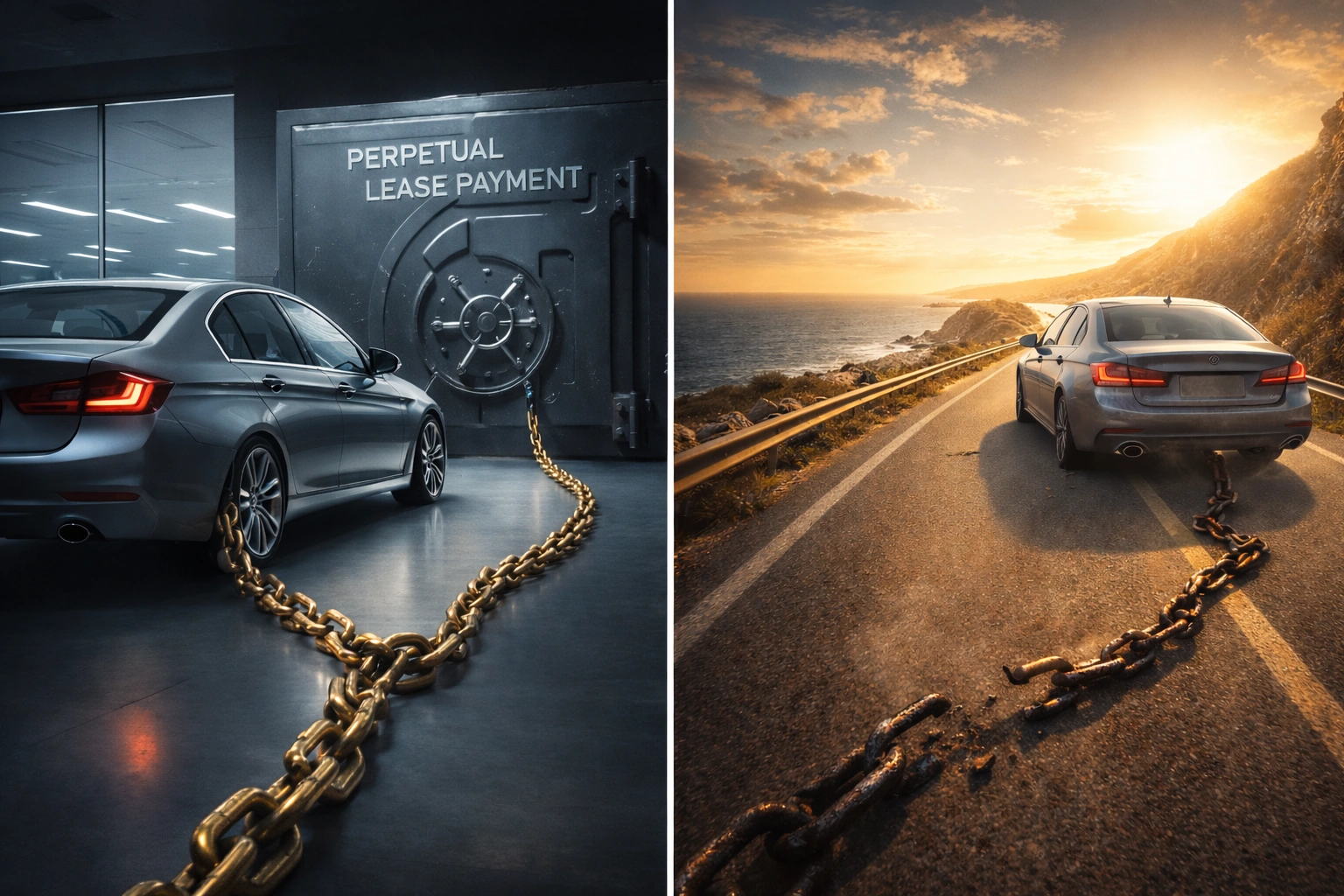
Executive Summary
In most financial scenarios, buying a car results in a lower total cost of ownership over a 6–10 year period compared to serial leasing. While leasing offers lower monthly payments, buying allows the owner to retain equity and eventually eliminate payments, whereas leasing is a perpetual expense that covers the steepest portion of the depreciation curve.
Here is the core financial reality of car leasing: You are financing the depreciation. When you lease, you are paying the bank for the privilege of driving a vehicle during its most expensive years, only to return it with zero equity. For most consumers, serial leasing results in higher long-term costs compared to buying and holding. Buying is an asset play; leasing is essentially a long-term rental service.
This analysis is part of our broader Smart Spending Guide on vehicle ownership costs, designed to help you avoid the “perpetual payment” cycle.
The Core Math: Renting vs. Owning Equity
Leasing means paying for the vehicle’s depreciation during the contract period, while buying means paying toward full ownership. Dealerships often focus on “monthly payments” to mask the total cost. The critical metric for decision-making is the Total Cost of Ownership (TCO) over a 6-year cycle.
| Financial Factor | Leasing (The Cycle) | Buying (The Asset) |
|---|---|---|
| Ownership Status | You own nothing (Renting) | You own the asset (Equity) |
| Long-Term Cost | Higher (Perpetual payments) | Lower (Payment stops eventually) |
| Monthly Payment | Lower (Short-term cash flow) | Higher (Building equity) |
| Mileage Limits | Strict penalties ($0.15-$0.25/mile) | Unlimited driving |
The Buying Strategy: You purchase a vehicle with a standard loan (e.g., 60 months). You pay principal plus interest. Once the loan is satisfied, the payment stops, and you own an asset worth $10,000–$15,000. This equity retention is crucial for offsetting the New vs Used Car Depreciation.
The 6-Year Financial Showdown
Let’s analyze the numbers on a $40,000 vehicle. We compare two scenarios: Serial Leasing (two consecutive 3-year leases) vs. Buy & Hold (one 6-year ownership period).
As illustrated in the chart above, the “Buying” scenario (blue line) sees cash outflow flatline after the loan term ends. In the “Leasing” scenario (green line), costs continue to climb indefinitely. Before committing, verify How Much Car You Can Afford using the 20/4/10 rule to ensure sustainability.
Trader’s Rule: The “Money Factor” Conversion
Dealers use “Money Factor” to represent interest rates on a lease. To calculate your actual APR, multiply the Money Factor by 2,400. For example, a Money Factor of 0.003 equals a 7.2% interest rate. Always compare this against current Credit Union Auto Loan Rates.
When Leasing Makes Financial Sense
While buying is generally more cost-effective for individuals, leasing can be the superior financial move in specific edge cases:
- Business Owners: If the vehicle qualifies for Section 179 or Bonus Depreciation, the tax savings can offset the higher cost of leasing.
- EV Technology Risk: Leasing transfers the risk of rapid battery depreciation and technological obsolescence to the bank.
The Hidden Costs of Leasing
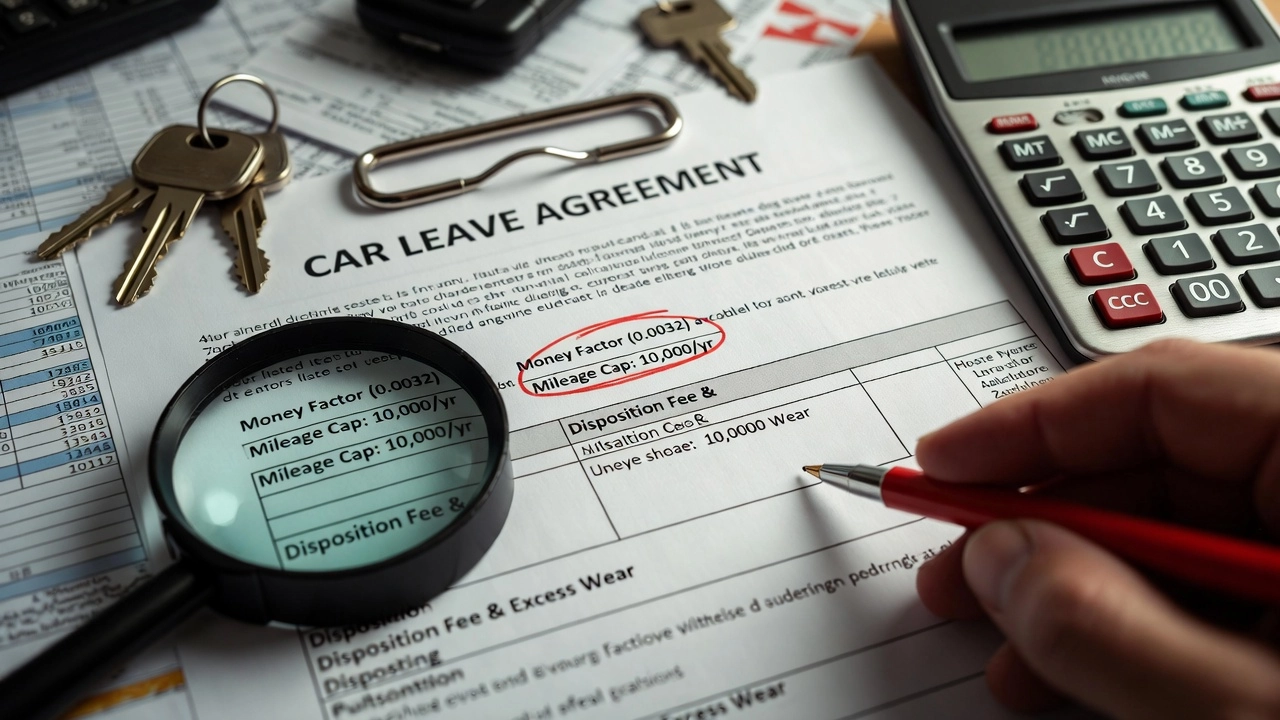
Lease contracts often include backend costs that are not reflected in the monthly payment. Be aware of the “Turn-In Shock”:
Mileage Limits: Most leases cap driving at 10,000–12,000 miles per year. Exceeding this limit results in penalties typically ranging from $0.15 to $0.25 per mile.
Wear & Tear: Dealers assess fees for scratches, dents, or interior stains upon return. Unlike owners who can choose when to repair cosmetic issues, lessees may be charged full retail repair rates.
Frequently Asked Questions
Is it cheaper to lease or buy a car?
In the long run, buying is significantly cheaper. While leasing offers lower monthly payments, you retain no asset after the term ends. Buying builds equity, allowing you to drive payment-free once the loan is paid off, which drastically reduces the total cost of ownership over 5+ years.
What costs more in the long run: leasing or buying?
Serial leasing costs more because you are perpetually paying for the steepest part of a car’s depreciation curve (the first 3 years). Over a 10-year period, leasing can cost $15,000–$20,000 more than buying and holding a reliable vehicle.
When does leasing make financial sense?
Leasing makes sense if you can deduct the payments as a business expense, if you want to shield yourself from EV technology depreciation, or if you prioritize driving a new car every 3 years over maximizing financial net worth.
How does car depreciation affect the decision?
Depreciation is the largest cost of vehicle ownership. Leasers pay for the massive value drop (40-50%) that occurs in the first 3 years. Buyers also suffer depreciation, but by holding the car for 6+ years, the annual cost of depreciation decreases significantly.
What happens at the end of a car lease?
At lease end, you have three options: return the car (and pay a disposition fee), purchase the car for its pre-set residual value, or trade it in for a new lease. Returning the car leaves you with zero equity and no vehicle.
Conclusion: Stop Renting Your Lifestyle
Leasing is primarily a lifestyle product, not a financial one. It allows you to drive a car you likely couldn’t afford to buy. But wealth is built by owning assets, not renting liabilities. Unless specific tax advantages apply, buying and holding remains the most prudent financial strategy.
Smart Spending Alert
Are you planning to buy or lease soon? Use the “20/4/10 Rule” before you walk into a dealership. If you can’t put 20% down, finance for 4 years or less, and keep expenses under 10% of your income, you are likely overextending your budget.