Executive Summary
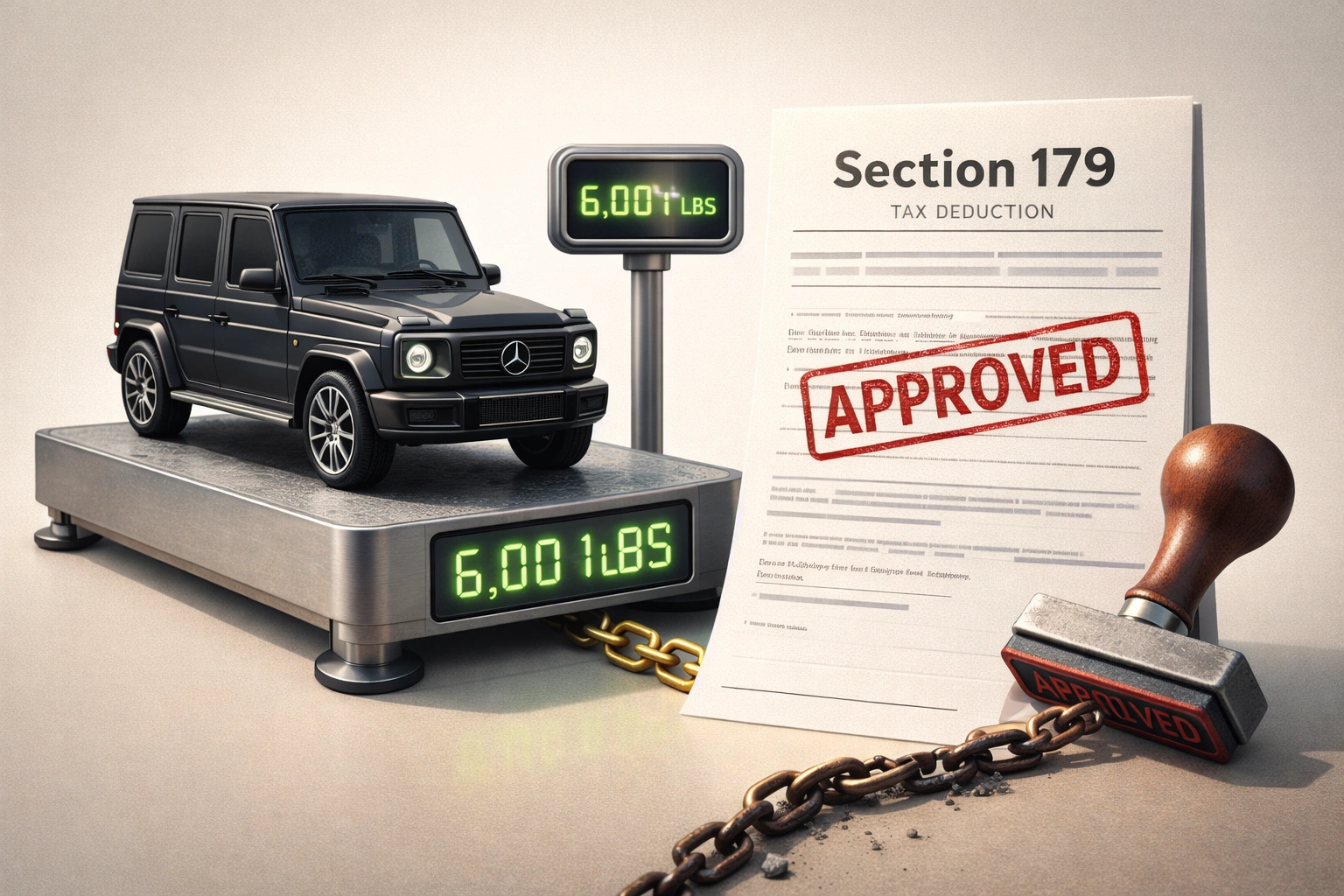
The “Section 179” tax code allows business owners to deduct up to 100% of the purchase price of a qualifying vehicle in the first year, provided it weighs over 6,000 lbs (GVWR). Unlike standard “luxury autos” which are capped at ~$20,000 in first-year depreciation, heavy SUVs and trucks are classified as “equipment,” unlocking massive tax savings for business use.
Why do so many real estate agents drive G-Wagons and doctors drive Tesla Model X’s? It’s not just about style; it’s about Gross Vehicle Weight Rating (GVWR). The IRS has strict depreciation limits on passenger cars to prevent taxpayers from subsidizing luxury sedans. However, vehicles built on a truck chassis or weighing over 6,000 lbs are exempt from these strict caps.
If you are a business owner or 1099 independent contractor, understanding this rule can effectively create a 30-40% discount on your next work vehicle through tax savings.
The “6,000 lbs” Rule Explained
The IRS separates vehicles into two main categories for depreciation:
- Passenger Autos (< 6,000 lbs): Subject to “Luxury Auto Limits.” The maximum first-year deduction is roughly $20,200 (2024/2025 figures). Even if you buy a $100,000 Porsche, you can only write off ~$20k in Year 1.
- Heavy SUVs & Trucks (> 6,000 lbs): Classified as transportation equipment. These qualify for the full Section 179 Deduction (up to the aggregate cap) and Bonus Depreciation (subject to phase-down schedules).
| Vehicle Type | Purchase Price | Max Year 1 Deduction | Tax Savings (35% Bracket) |
|---|---|---|---|
| Sedan (e.g., Camry) | $80,000 | ~$20,200 (Capped) | $7,070 |
| Heavy SUV (>6,000 lbs) | $80,000 | $80,000 (Full) | $28,000 |
*Assumes 100% business use. Tax savings vary by individual bracket.
The “Heavy List”: Top Vehicles That Qualify
To qualify, the vehicle must have a GVWR (Gross Vehicle Weight Rating) greater than 6,000 lbs. This is not the curb weight; it is the maximum loaded weight found on the driver’s door sticker.
Popular SUVs
- Tesla Model X (GVWR > 6,000 lbs)
- Mercedes G-Class (G-Wagon)
- Cadillac Escalade
- Chevrolet Tahoe / Suburban
- Range Rover (Full size)
- Jeep Grand Cherokee L (Check spec)
- BMW X5 / X7 (Check specific trims)
Trucks (Always Qualify)
- Ford F-150 / F-250
- Chevrolet Silverado 1500+
- Ram 1500+
- Toyota Tundra
- Rivian R1T / R1S
The “Bonus Depreciation” Phase-Down Alert
Section 179 is powerful, but “Bonus Depreciation” is fading. Bonus depreciation allowed you to deduct the full amount regardless of business income profitability. Section 179 cannot create a net operating loss (you must have profit to use it).
As we move into 2026, Bonus Depreciation drops to 20%. This means Section 179 is now the primary tool. You must have enough business profit to absorb the deduction.

Critical Requirements (Don’t Get Audited)
Just buying a heavy car isn’t enough. To bulletproof your tax return against an audit, you must meet these criteria:
- More than 50% Business Use: You must drive the car for business more than personal use. If you drive 60% for business, you can deduct 60% of the cost. If you dip below 50%, you qualify for nothing (Section 179 recapture applies).
- Title in Company Name: Ideally, buy the vehicle under your LLC or Corp name.
- Mileage Log is Mandatory: “I guessed” is not a defense. Use an app like MileIQ to track every trip.
Frequently Asked Questions
Does a Porsche Cayenne qualify for Section 179?
It depends on the specific model year and trim. Many newer Cayennes have a GVWR over 6,000 lbs, making them eligible. Always check the manufacturer’s sticker on the door jamb before purchasing.
Can I take Section 179 on a used car?
Yes. Section 179 applies to both new and “new to you” (used) vehicles. The vehicle just needs to be placed in service for business use for the first time by you.
What if I sell the car after 2 years?
If you sell the car, you may have to pay “depreciation recapture” tax. Since you wrote off the whole car upfront, the IRS views the sale price as 100% taxable gain (ordinary income), not capital gains.
Is there a limit on SUV deductions?
Yes. While Section 179 has a general cap ($1M+), heavy SUVs (6,000-14,000 lbs) specifically have an inflation-adjusted cap (approx $30,500 for Section 179 itself, plus remaining basis via Bonus Depreciation/MACRS). Consult your CPA for the exact current year split.
Conclusion: The “Discount” is Real, But Follow the Rules
Buying a heavy vehicle for your business is one of the last great tax shelters remaining for small business owners. It effectively allows you to buy a $80,000 truck for a net cost of $50,000 after tax savings. However, never let the “tax tail wag the dog”—only buy the truck if your business actually needs it.
Smart Spending Alert
Buying an Electric Heavy SUV? You might double-dip! Vehicles like the Tesla Model X or Rivian R1T may qualify for both the Section 179 deduction AND the $7,500 Commercial EV Tax Credit.