Fuel Prices Up? How to save money
on gas With 5 Easy Hacks
You cannot control global oil markets, geopolitical tensions, or refinery shortages. However, you maintain absolute control over the mathematical efficiency of your vehicle. The average American commuter burns up to 30% more fuel than necessary due to a combination of aggressive driving habits, poor vehicle maintenance, and a failure to optimize payment methods at the pump. By treating your daily commute as an exercise in aerodynamics and cash-flow management—leveraging predictive routing apps, maintaining optimal tire pressure, and stacking station loyalty programs with high-yield cash back cards—you can drastically lower your transportation costs → starting today.
This article is for you if:
✓Your monthly fuel budget is heavily impacting your ability to save or invest
✓You drive an older, less fuel-efficient vehicle or a heavy SUV/Truck
✓You want to know the truth about “Premium” vs. “Regular” gasoline
CReviewed by BMT Household Economics Desk·
Sources: U.S. DOE, AAA · Action Guide
THE EFFICIENCY GAP
15-30%
Fuel economy lost to aggressive driving and speeding
U.S. DOE Analytics · Full sources → SEC 06
IDLING
0 MPG
Wastes a quarter gallon per hour
TIRE PSI
+3%
Mileage gain from proper inflation
Key Fuel Hacks
1The Speed Penalty: Every 5 mph you drive over 50 mph is mathematically equivalent to paying an extra $0.30 per gallon.
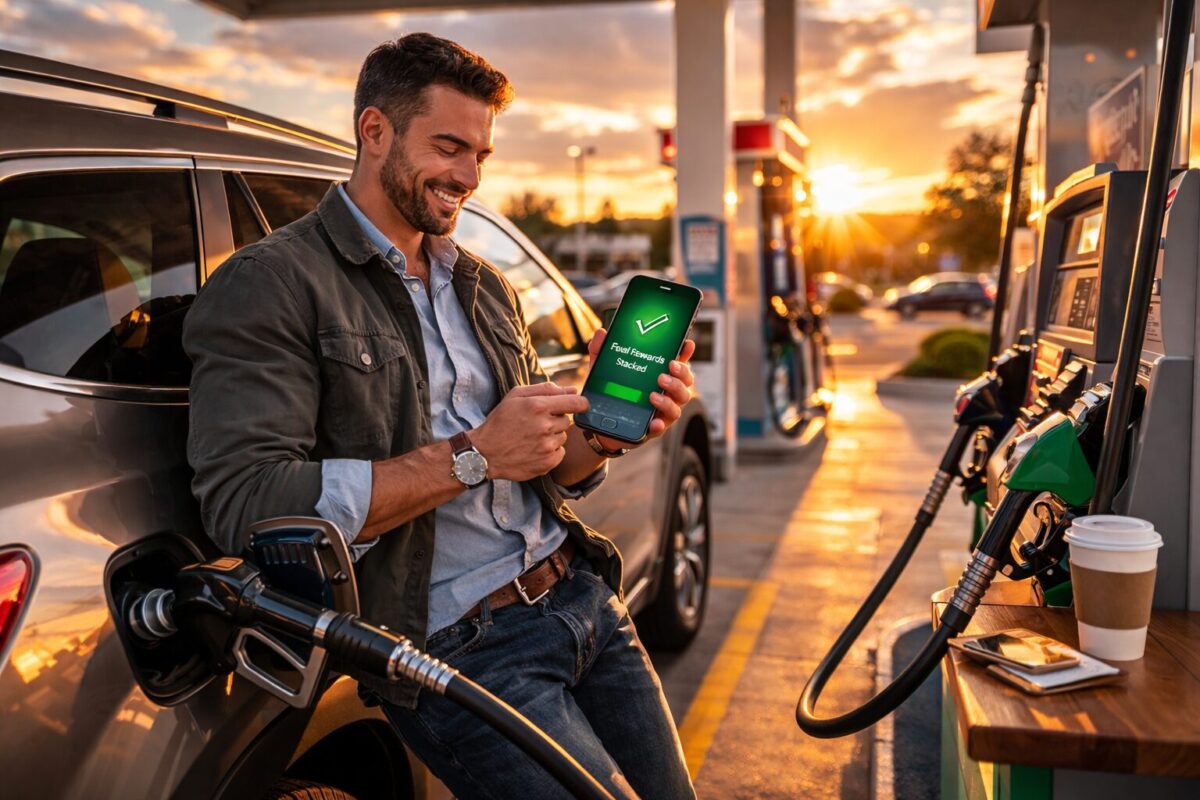
2The Stacking Strategy: Combine a gas station’s free loyalty app (e.g., Shell Fuel Rewards) with a 5% cash back credit card.
3Weight Reduction: Remove heavy tools, golf clubs, and roof racks when not in use. Excess weight kills city mileage.
Disclaimer: This article provides behavioral and mechanical strategies for reducing fuel consumption. Always consult your vehicle’s owner’s manual for specific maintenance requirements, oil grades, and recommended gasoline octane levels.
SEC 02PROBLEM— The Behavioral Drain
SECTION 02 — THE PROBLEM
You Are Driving Like You Are on a Racetrack
The internal combustion engine is incredibly inefficient; much of the energy from gasoline is lost to heat and exhaust. When you slam on the accelerator at a green light only to slam on the brakes at the next red light, you are literally dumping unburned fuel out of your tailpipe. Aerodynamic drag increases exponentially with speed. Driving 75 mph on the highway instead of 65 mph can reduce your fuel economy by 15% immediately.
Beyond driving habits, consumers lose hundreds of dollars a year by being completely passive at the payment terminal. Swiping a standard debit card at the closest, most convenient gas station ensures you pay the maximum retail price. To win, you must adopt the “Hyper-Miler” mindset: driving smoothly, maintaining perfect tire pressure, and forcing gas stations to give you a discount through loyalty programs.
The Aggressive Payer
Accelerates rapidly from stoplights and brakes extremely hard
Ignores the Tire Pressure Monitoring System (TPMS) warning light
Pulls into the first gas station they see off the highway exit (Highest prices)
Pays for Premium (91 Octane) when the manual only “Recommends” it
The Hyper-Miler Optimizer
Accelerates gently and anticipates red lights to coast to a stop
Checks tire PSI monthly and keeps them inflated to the door jamb spec
Checks the GasBuddy app to find a station 5 cents cheaper per gallon
Stacks a station loyalty card ($-0.05/gal) with a 5% Cash Back credit card
MECHANICAL WATCH OUT
The Premium Fuel Scam. If your car’s owner’s manual says “Premium Gas REQUIRED,” you must use it to prevent engine knocking. However, if the manual says “Premium Gas RECOMMENDED,” you can safely use Regular (87 Octane). The engine’s computer will automatically adjust. You might lose 2-3 horsepower, but you will save $0.50 to $0.80 per gallon at the pump, saving you hundreds over the year.
SEC 03EVIDENCE— Data + Sources (E-E-A-T)
SECTION 03 — EVIDENCE & DATA
The Anatomy of Wasted Fuel
Estimated annual gas cost for a standard commuter (15,000 miles/year)
Annual Savings+$550
Behavioral errors (Speeding, hard braking, idling)
Mechanical/Physical errors (Tire PSI, drag)
Primary DrainSpeed
Source: U.S. Department of Energy (fueleconomy.gov), AAA Fuel Analytics
SEC 04FAQ— Efficiency Mechanics
SECTION 04 — FAQ
Frequently Asked Questions
No. This is an outdated myth from the era of carburetors. Modern fuel-injected engines use almost zero extra fuel to restart. The Department of Energy states that if you are going to be stopped for more than 10 seconds (e.g., waiting at a train crossing or a drive-thru), turning the engine off mathematically saves fuel.
Absolutely not. The number on the side of the tire is the structural maximum, not the optimal operating pressure. Inflating to the max will ruin your suspension and reduce traction. Always inflate your tires to the precise number listed on the sticker inside the driver’s side door jamb (usually around 32-35 PSI).
It depends on your speed. In city driving (under 45 mph), rolling the windows down is more efficient because the A/C compressor drains engine power. However, on the highway (over 55 mph), rolling windows down creates massive aerodynamic drag (wind resistance) that destroys your MPG. On the highway, roll them up and use the A/C.
SEC 05DECISION— If/Then Framework
SECTION 05 — DECISION SUPPORT
The Fuel Optimization Matrix
Use this tactical framework to execute specific behavioral changes and optimize your financial transactions at the pump.
Your Situation (IF)Recommendation (THEN)
You commute daily on an open, flat highway for more than 10 miles
Human feet naturally fluctuate speed, wasting fuel
Engage Cruise Control immediately to save 7% to 14% on gas.
You have an empty roof rack or cargo box installed on your SUV
Roof racks destroy your vehicle’s aerodynamic profile
Remove the rack entirely until your next road trip.
You are paying at the pump with a standard Debit Card
You are leaving free money on the table
Sign up for a Station App (e.g., BPme) AND link a 5% gas Cash Back card.
Your check engine light is on, or your car failed an emissions test
A faulty oxygen sensor can drop mileage by 40%
Get a tune-up immediately. The repair pays for itself in gas savings.
CPA COMMENT — 80% GUIDE
Do not burn gas to save gas. A common mistake is driving 10 miles out of your way just to save 5 cents a gallon at a specific station. If your car gets 20 MPG and gas is $3.50, driving 10 miles costs you $1.75 in fuel. If you only pump 15 gallons, you saved $0.75 but spent $1.75. You lost $1.00 on the trip. Always use an app to find the cheapest gas along your existing route.
Do not burn gas to save gas. A common mistake is driving 10 miles out of your way just to save 5 cents a gallon at a specific station. If your car gets 20 MPG and gas is $3.50, driving 10 miles costs you $1.75 in fuel. If you only pump 15 gallons, you saved $0.75 but spent $1.75. You lost $1.00 on the trip. Always use an app to find the cheapest gas along your existing route.