High Energy Costs? How to lower
utility bills by 30% Fast
Utility companies operate as localized monopolies. Because you cannot easily switch providers, they rely on your behavioral inertia to maximize their profits. You are likely paying up to 30% more than necessary every month due to “Phantom Loads” (appliances draining electricity while turned off) and a complete misunderstanding of “Time-of-Use” (TOU) pricing architectures. By simply treating your household’s energy consumption like a corporate P&L statement—auditing your HVAC efficiency, automating your thermostat, and aggressively shifting heavy power loads to off-peak hours—you can instantly slash your monthly utility bills → without sacrificing your standard of living.
This article is for you if:
✓Your summer AC or winter heating bills are consistently destroying your monthly budget
✓You leave computers, chargers, and entertainment systems plugged in 24/7
✓You want a strict, actionable mathematical formula to lower your energy costs today
CReviewed by BMT Household Economics Desk·
Sources: U.S. DOE, Energy Star · Action Guide
THE TARGET METRIC
-30%
Optimal reduction in monthly energy expenditure
Energy Efficiency Standards · Full sources → SEC 06
THE DRAIN
10%
Lost to “Vampire” phantom power
HVAC LOAD
50%
Heating and cooling costs
Key Utility Facts
1Time-of-Use (TOU): Electricity can cost double if you run the dishwasher or dryer between 4 PM and 9 PM.
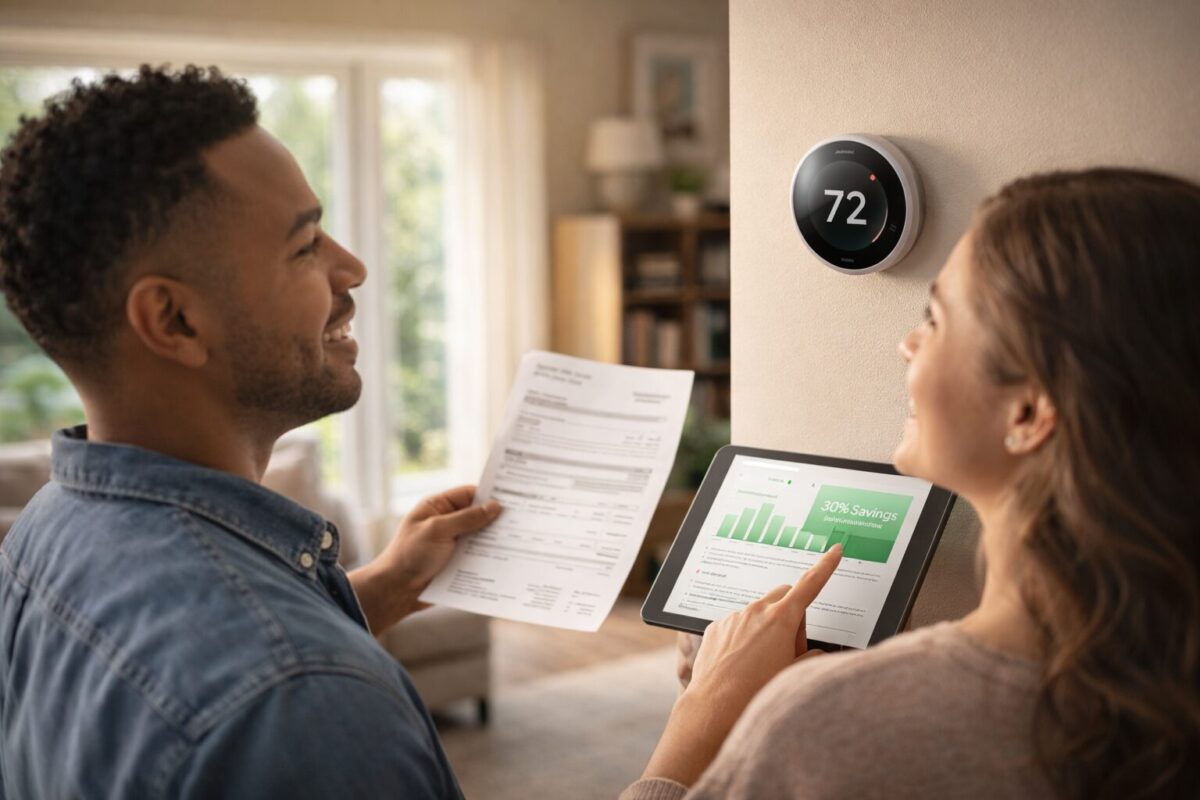
2Smart Automation: A programmable thermostat pays for itself within 6 months by dropping temps while you sleep or work.
3Water Heaters: Lowering your water heater from 140 degrees to 120 degrees saves hundreds annually with zero perceived difference.
Disclaimer: This article provides mathematical and behavioral strategies for reducing household expenses. Actual savings will vary based on your local utility company’s rate structure, regional climate, and the square footage of your home.
SEC 02PROBLEM— The Inefficiency Trap
SECTION 02 — THE PROBLEM
You Are Paying for “Ghost” Electricity
The standard American household wastes a staggering amount of capital by treating electricity as a flat, invisible utility. You come home from work at 6:00 PM, crank the air conditioning, turn on the oven, and run a load of laundry. What the utility company doesn’t tell you is that you are doing this during “Peak Pricing Hours.” Under a Time-of-Use (TOU) plan, the electricity you use at 6:00 PM can cost up to 50% more per kilowatt-hour (kWh) than the exact same electricity used at 11:00 PM.
Furthermore, modern electronics (TVs, gaming consoles, coffee makers) never truly turn off; they enter a “standby mode” that constantly draws power. This “Phantom Load” or “Vampire Draw” accounts for up to 10% of a residential energy bill. You are literally bleeding cash while you sleep. To fix this, you must stop being a passive consumer and start actively defending your household’s energy architecture.
The Passive Consumer
Leaves the AC running at 70 degrees all day while the house is empty
Runs the dishwasher and washer/dryer during 5 PM peak hours
Ignores drafty windows, letting expensively heated air escape
Keeps the water heater permanently set to a scalding 140 degrees
The Energy Optimizer
Installs a smart thermostat to drop energy use automatically when away
Delays heavy appliance usage until after 10 PM to exploit off-peak rates
Uses $15 weather stripping to seal gaps and lock in HVAC efficiency
Deploys smart power strips to instantly kill power to idle electronics
INFRASTRUCTURE WATCH OUT
The HVAC Filter Penalty. The heating and cooling system (HVAC) is responsible for over 50% of your entire energy bill. If you fail to change your $15 air filter every 3 months, the system has to work twice as hard to push air through the clogged dust. This single oversight can silently increase your HVAC energy consumption by 15%, while simultaneously destroying the motor and leading to a massive repair bill.
SEC 03EVIDENCE— Data + Sources (E-E-A-T)
SECTION 03 — EVIDENCE & DATA
The Anatomy of Your Utility Bill
HVAC (The most critical target for cost reduction)
Vampire Draw (10% of your bill is entirely wasted)
Primary TargetHVAC
Estimated annual savings by deploying a smart thermostat and off-peak shifting
Annual Savings+$720
Source: U.S. Department of Energy (DOE), BMT Household Economics Data
SEC 04FAQ— Efficiency Mechanics
SECTION 04 — FAQ
Frequently Asked Questions
TOU is a rate plan where the utility company charges you different prices for electricity depending on the time of day. “Peak” hours (usually 4 PM to 9 PM) are the most expensive because everyone is home using power. “Off-peak” hours (late night and early morning) are heavily discounted. Shifting your laundry and dishwasher to off-peak times slashes your bill instantly.
Mathematically, yes. A smart thermostat (like Nest or Ecobee) learns your schedule and automatically adjusts the temperature when you leave the house or go to sleep. The U.S. Department of Energy estimates they save users 10% to 15% on heating and cooling annually. It effectively pays for itself within the first 6 to 9 months of use.
No, manually unplugging cords is unsustainable behavior. Instead, buy a “Smart Power Strip” or “Advanced Power Strip” (APS). You plug your TV into the master outlet, and your speakers/consoles into the secondary outlets. When you turn off the TV, the strip automatically cuts power to the other devices, killing the phantom load automatically.
SEC 05DECISION— If/Then Framework
SECTION 05 — DECISION SUPPORT
The Energy Cost Reduction Matrix
Use this tactical framework to execute immediate structural changes to your household energy consumption.
Your Situation (IF)Recommendation (THEN)
You run the dishwasher or washer/dryer immediately after dinner (6 PM)
You are paying peak pricing premiums for heavy loads
Use the “Delay Start” button to run them at 11 PM (Off-Peak).
Your home feels drafty and the heater runs constantly in winter
Your heated air is leaking out through windows and doors
Apply cheap caulk and weather stripping to seal the thermal envelope.
Your water heater is set to the factory default (140 degrees)
You are constantly boiling water you don’t need
Lower the dial to 120 degrees to save up to 10% on water heating costs.
You want a customized, professional plan to lower your specific bill
Utility companies often offer hidden free services
Call your utility provider and request a “Free Energy Audit”.
CPA COMMENT — 80% GUIDE
Do not overlook LED bulb conversion. If you still have incandescent or halogen bulbs, you are actively burning money. An LED bulb uses up to 90% less energy and lasts 25 times longer. Replacing the 5 most heavily used lightbulbs in your house (kitchen, living room, porch) with LEDs will yield an immediate, measurable drop in your monthly kWh consumption.
SERIES
Household Cost System
1 / 9 published
1
High Energy Costs? How to lower utility bills by 30% Fast
← NOW
2Paying Too Much? Best cheap car insurance Options for 2026
3Stop Cable Fees: Cut the cord cable alternatives to Save $100
4Fuel Prices Up? How to save money on gas With 5 Easy Hacks
5Budget Tight? The cheapest streaming services 2026 Ranked
6Always Broke? How to stop impulse buying and Save Cash Now
7Earn Zero Interest? Best high yield checking accounts 2026
8Premium Spike? How to lower home insurance in Just 3 Steps
9Track Every Penny: Top free budgeting apps 2026 You Need Now
Do not overlook LED bulb conversion. If you still have incandescent or halogen bulbs, you are actively burning money. An LED bulb uses up to 90% less energy and lasts 25 times longer. Replacing the 5 most heavily used lightbulbs in your house (kitchen, living room, porch) with LEDs will yield an immediate, measurable drop in your monthly kWh consumption.