Why Your Bank Account is Losing
You Money (And How to Fix It)
Keeping your emergency fund in a traditional brick-and-mortar bank is a guaranteed way to lose wealth. While inflation eats your purchasing power at 3% a year, mega-banks pay you a microscopic 0.01%. It takes less than 10 minutes to move your cash to a High-Yield Savings Account (HYSA) → and instantly start earning 400x more interest with the exact same FDIC protection.
This article is for you if:
✓You keep more than $5,000 in a Chase, BofA, or Wells Fargo savings account
✓You want to earn passive income safely without investing in the stock market
✓You are confused about whether online-only banks are actually safe
CReviewed by BMT Financial Board·
Sources: FDIC, Federal Reserve · For informational purposes only
INFLATION LOSS
-$300/yr
Lost purchasing power on $10k sitting in a standard bank
FDIC Data 2026 · Full sources → SEC 06
HYSA
4.50%
Top online APY
MEGA BANK
0.01%
Chase / BofA
Key Facts
1Big banks rely on customer laziness to pay zero interest on deposits
2Online HYSAs offer the exact same $250,000 FDIC insurance as traditional banks
3HYSA rates are variable and will fluctuate based on the Federal Reserve
Disclaimer: This article is for informational purposes only. Annual Percentage Yields (APY) are subject to change without notice based on market conditions. Always verify current rates with the specific financial institution.
SEC 02PROBLEM— The Cost of Laziness
SECTION 02 — THE PROBLEM
The 0.01% Trap is Costing You Hundreds Every Year
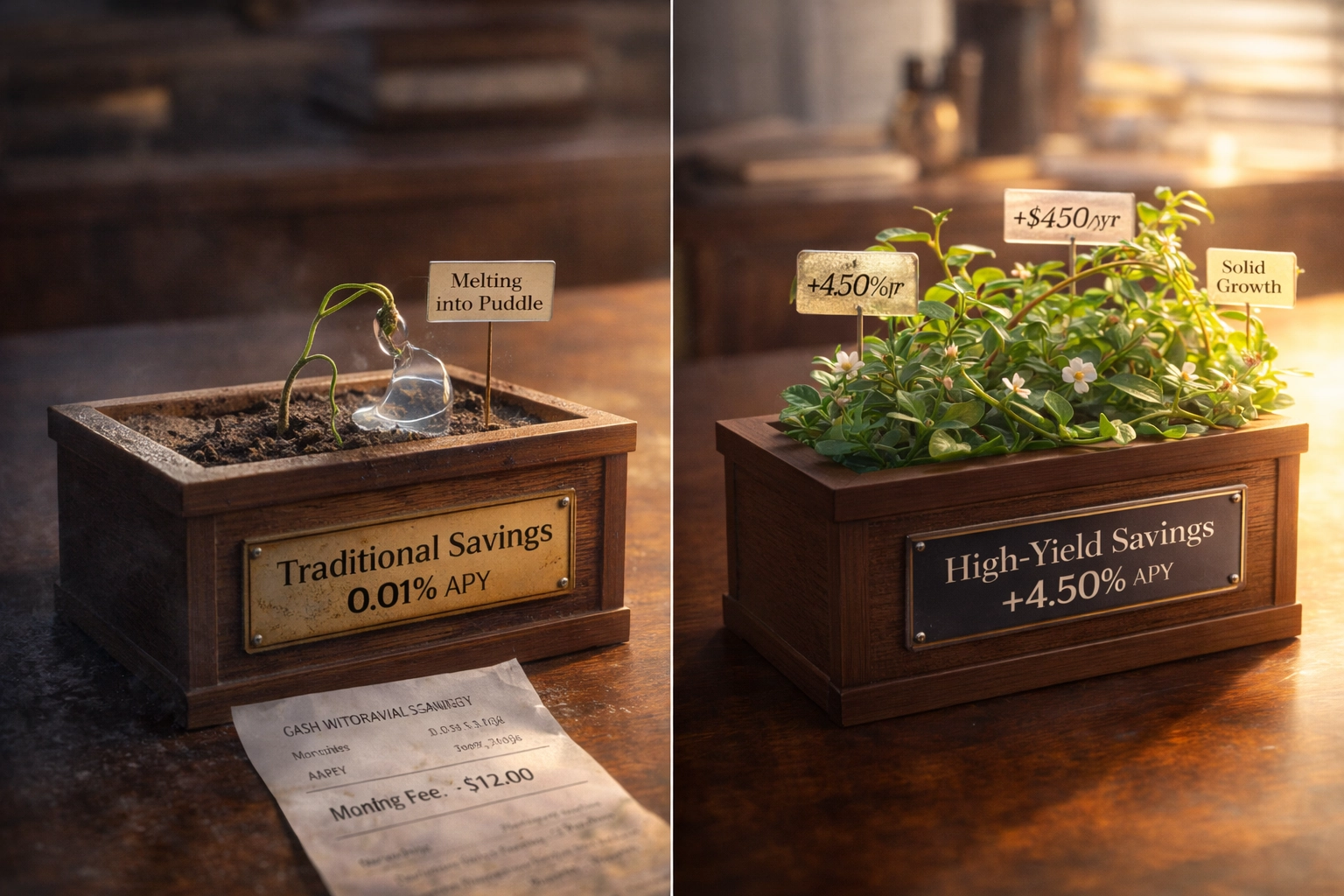
When you deposit money into a traditional bank, they immediately turn around and lend it out for mortgages and auto loans at 7% or 8%. In exchange for using your money, they pay you a staggering 0.01%. If you have $10,000 saved, they are paying you a single dollar bill for the entire year. Meanwhile, FDIC-insured online banks do not have to pay for thousands of expensive physical branches and tellers, so they pass those savings directly back to you in the form of a 4.5% or 5.0% APY.
Traditional Big Bank
Pays 0.01% APY (Earns $1/yr on $10k)
Charges $12/month if your balance drops too low
Money loses value daily to 3% inflation
Requires physical visits for basic services
Online HYSA
Pays ~4.50% APY (Earns $450/yr on $10k)
Zero minimum balance requirements and zero monthly fees
Interest compounds daily and is paid out monthly
Seamless 24/7 app access and electronic transfers
FINANCIAL WATCH OUT
Introductory Rate Traps. Some banks will advertise a massive 5.5% APY to get you to sign up, but read the fine print. Often, this is a “promotional rate” that drops down to 1% after three months. Stick to reputable, established online banks (like Ally, Marcus, or Discover) that offer consistently high rates without gimmicks.
SEC 03EVIDENCE— Data + Sources (E-E-A-T)
SECTION 03 — EVIDENCE & DATA
The Mathematical Advantage of an HYSA
Current Annual Percentage Yield (APY)
HYSA Advantage450x
$10,000 Compounded Annually at 4.5%
Free Cash Earned+$2,461
Source: FDIC National Rates and Rate Caps (2026)
SEC 04FAQ— People Also Ask
SECTION 04 — FAQ
Frequently Asked Questions
Yes, absolutely. As long as the bank is FDIC insured (which you should verify on their website), your deposits are protected up to $250,000 per depositor, per institution, against bank failure. It is the exact same federal guarantee that protects your money at traditional brick-and-mortar banks.
You simply link your HYSA to your existing checking account electronically. When you need the money, you initiate a transfer via the app, and the funds usually clear within 1 to 3 business days. Many HYSAs also offer ATM access for direct withdrawals if needed.
No. Unlike a Certificate of Deposit (CD), HYSA rates are variable. They go up and down based on the Federal Reserve’s benchmark interest rate. However, even when rates drop across the board, HYSAs will always pay significantly more than traditional mega-banks.
Yes. The IRS considers interest earned in a savings account to be taxable income. At the end of the year, your bank will send you a 1099-INT form detailing exactly how much you earned so you can report it on your tax return.
SEC 05DECISION— If/Then Framework
SECTION 05 — DECISION SUPPORT
Where Should You Keep Your Cash?
Use this liquidity guide to organize your accounts and maximize your monthly yield.
Your Situation (IF)Recommendation (THEN)
Money needed to pay rent or bills this week
Needs instant access with zero transfer delays
Leave in Local Checking
Your 3 to 6 month emergency fund
Needs safety, growth, and moderate liquidity
Move to Online HYSA
Cash for a house downpayment needed in 1 year
You want to lock in a guaranteed fixed rate today
Buy a 12-Month CD
Money you won’t need for 10+ years
Cash will lose to inflation over long periods
Invest in the Stock Market
EDITOR’S COMMENT — 80% GUIDE
The best financial setup is hybrid. Keep your traditional checking account at a local bank for paying bills and withdrawing physical cash. Then, automate a monthly transfer of your savings directly to an online HYSA. You get the convenience of a physical branch and the high yields of an online bank.
SERIES
Smart Banking Strategies
1 / 9 published
1
Why Your Bank Account is Losing You Money (And How to Fix It)
← NOW
2Online vs Traditional Banks: Stop Paying $12/Month for Nothing
3The Overdraft Protection Trap: How Banks Legally Steal Your Money
4The Real Emergency Fund: How Much Cash Do You Actually Need?
5CD vs HYSA: Where Should You Park Your Savings?
6Cash Advance Apps: A Lifeline or Just a Modern Payday Loan?
7Blacklisted by Banks? How to Beat ChexSystems and Get an Account
8FDIC Insurance Explained: Is Your Money Actually Safe?
9Automate Your Money: The “Set It and Forget It” Budget Hack
The best financial setup is hybrid. Keep your traditional checking account at a local bank for paying bills and withdrawing physical cash. Then, automate a monthly transfer of your savings directly to an online HYSA. You get the convenience of a physical branch and the high yields of an online bank.