Track Every Penny: Top free budgeting
apps 2026 You Need Now
Mega-banks profit immensely from your disorganization. By keeping you in a state of “Financial Fog”—where you are unaware of your daily cash flow until your card is declined—banks extract billions annually in overdraft and non-sufficient funds (NSF) fees. You do not need to pay a $100 annual subscription to build a financial fortress. The top free budgeting apps in 2026 utilize secure Open Banking APIs to automatically aggregate your transactions, forcing you to confront your behavioral spending leaks in real-time. However, many “free” platforms act as Trojan horses, aggressively mining your data to push high-interest loans. Here is the CPA-vetted guide to navigating the free budgeting apps 2026 market →, protecting your privacy, and deploying a Zero-Based Budget that puts you in absolute control.
This article is for you if:
✓You frequently wonder where your paycheck went by the 20th of the month
✓You want to automate your expense tracking without paying a monthly subscription fee
✓You need a systemic way to implement the Envelope System or Zero-Based Budgeting
CReviewed by BMT Household Economics Desk·
Sources: CFPB, FTC · Commercial Guide
THE GOAL
Zero-Based
Income minus expenses must equal exactly zero every month
Financial Optimization · Full sources → SEC 06
SOFTWARE COST
$0.00
No need for expensive subscriptions
RECOVERY
15-20%
Average hidden cash found by tracking
Key Commercial Facts
1The API Standard: Modern apps use read-only aggregators like Plaid. They can see your transactions but cannot move your money.
2Freemium Models: Most free apps will relentlessly upsell you to their “Premium” tier. You must have the discipline to ignore the upgrades.
3Manual vs. Auto: Linking bank accounts is convenient, but manually entering every receipt forces maximum psychological accountability.
Disclaimer: This article reviews commercial financial software based on the 2026 US Market. We do not receive direct compensation for recommending these specific apps. When using “free” financial tools, carefully read their privacy policies, as many monetize by recommending third-party credit cards or investment services.
SEC 02PROBLEM— The Financial Fog
SECTION 02 — THE PROBLEM
Mental Math is a Mathematical Failure
The human brain is fundamentally incapable of tracking hundreds of micro-transactions across multiple credit cards, checking accounts, and Venmo transfers. When you rely on “mental math” to gauge how much money you have left for the month, you inevitably succumb to optimism bias. You remember the $1,500 rent payment, but your brain conveniently forgets the six $15 lunches, the $45 Amazon purchase, and the three overlapping streaming subscriptions. This behavioral blind spot is the foundation of consumer debt.
To defend your cash flow, you must externalize your memory into a dedicated software system. However, paying $15 a month for a premium budgeting app when you are already struggling to save money is counterproductive. The modern solution is deploying high-quality, free software to execute Zero-Based Budgeting. This framework dictates that every single dollar of your income is assigned a specific “job” (rent, groceries, savings, debt payoff) on day one of the month, leaving exactly $0 unaccounted for.
The Reactive Spender
Checks their bank balance once a week to see if their card will decline
Relies purely on mental math to track remaining discretionary cash
Views budgeting as a “punishment” that restricts their freedom
Pays $35 overdraft fees because an autopay bill hit one day early
The Zero-Based Architect
Uses a free app to categorize every transaction within 24 hours
Assigns every dollar a designated category before the month begins
Views the budget as a tool that gives them permission to spend guilt-free
Tracks Net Worth macro-trends while controlling micro-expenses
SECURITY WATCH OUT
The “Free” Data Trap. If a budgeting app is entirely free and has no premium upgrade option, you are the product. Many aggressively free apps harvest your anonymized transaction history to sell to corporate marketing firms, or they generate revenue by heavily pushing affiliate credit cards inside the app. Always use software that clearly outlines how they monetize your usage in their privacy policy.
SEC 03EVIDENCE— Data + Sources (E-E-A-T)
SECTION 03 — EVIDENCE & DATA
The Economics of Budget Software
Average monthly discretionary cash outflow comparison
Cash Recovered+$700
Direct user upgrades (The safest monetization method)
Yes, if the app uses a legitimate third-party aggregator like Plaid or Finicity. These systems use tokenized, read-only connections. This means the budgeting app can only “see” your transactions to categorize them; they do not have the technical ability to move, withdraw, or transfer your money.
Zero-Based Budgeting is a mathematical rule where Income minus Expenses equals zero. If you make $4,000 a month, you must assign every single dollar a job before the month starts. $1,500 to rent, $500 to food, $1,000 to debt, and $1,000 to savings. There is no “leftover” money floating around in a void waiting to be wasted.
Most legitimate apps use a “Freemium” model. They give you basic expense tracking for free, but lock advanced features (like custom charts, automatic bank syncing, or shared household budgets) behind a paywall. Others, like Empower, are 100% free because they use the app to identify high-net-worth individuals to pitch their paid wealth management services.
SEC 05DECISION— If/Then Framework
SECTION 05 — DECISION SUPPORT
The Software Selection Matrix
Use this commercial framework to match the app’s methodology to your personal financial discipline level.
Your Situation (IF)Recommendation (THEN)
You want a fully automated dashboard showing all your accounts and net worth
You don’t want to type in every single coffee purchase manually
Use Empower Personal Dashboard (100% free, excellent macro tracking).
You want to strictly use the “Envelope System” but in a digital format
You are willing to do manual data entry for higher accountability
Use Goodbudget’s free tier. (Excellent for strict envelope control).
You want a dedicated Zero-Based Budget layout to plan out every dollar
You are following debt payoff methods like the Baby Steps
Use EveryDollar’s free tier. (Requires manual entry, but perfect UI).
Your main problem is forgotten recurring subscriptions and high cable bills
You need an app to audit and negotiate your fixed costs
Use Rocket Money’s free tier to expose hidden subscriptions.
CPA COMMENT — 80% GUIDE
Automation is a double-edged sword. When an app automatically categorizes your transactions, you lose the psychological “pain” of confronting your spending. If you are struggling with severe credit card debt, do not use an automated app. You must use a manual entry app (or a physical spreadsheet) for at least 90 days. The sheer annoyance of manually typing in $6 for a coffee is exactly what cures impulse buying.
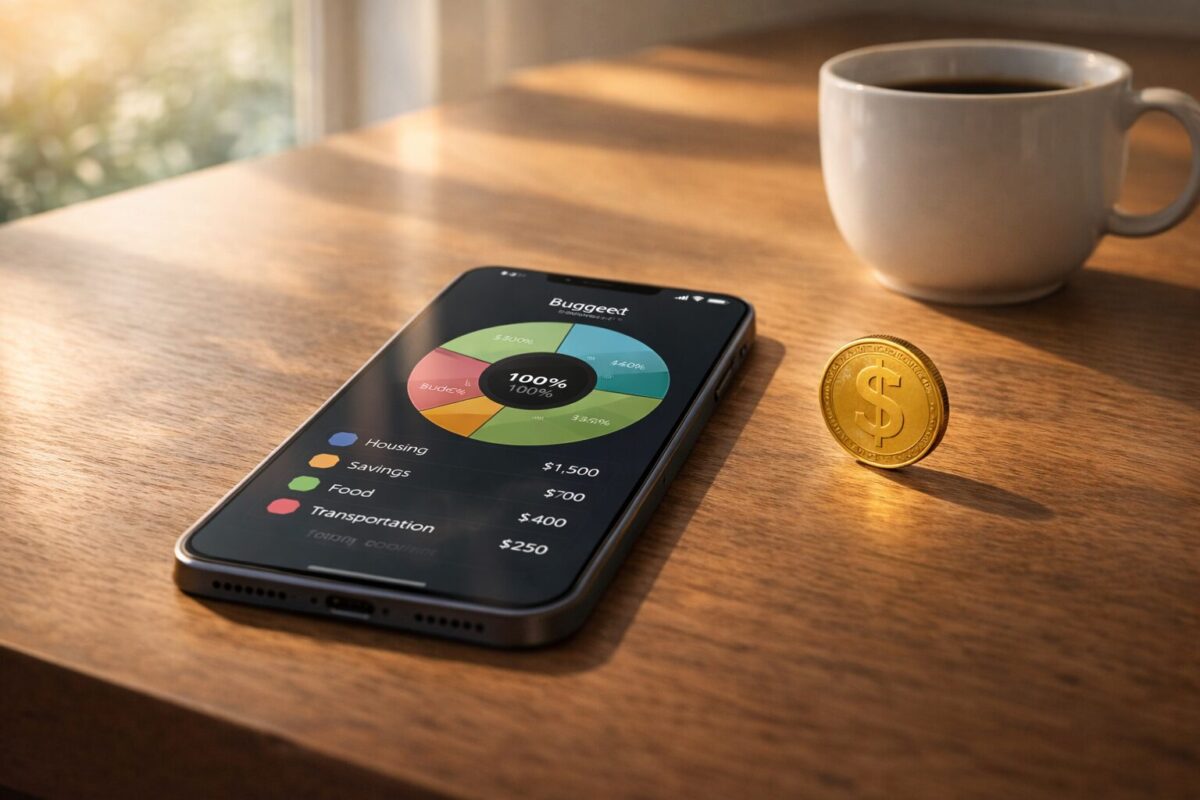
Automation is a double-edged sword. When an app automatically categorizes your transactions, you lose the psychological “pain” of confronting your spending. If you are struggling with severe credit card debt, do not use an automated app. You must use a manual entry app (or a physical spreadsheet) for at least 90 days. The sheer annoyance of manually typing in $6 for a coffee is exactly what cures impulse buying.