Executive Warning
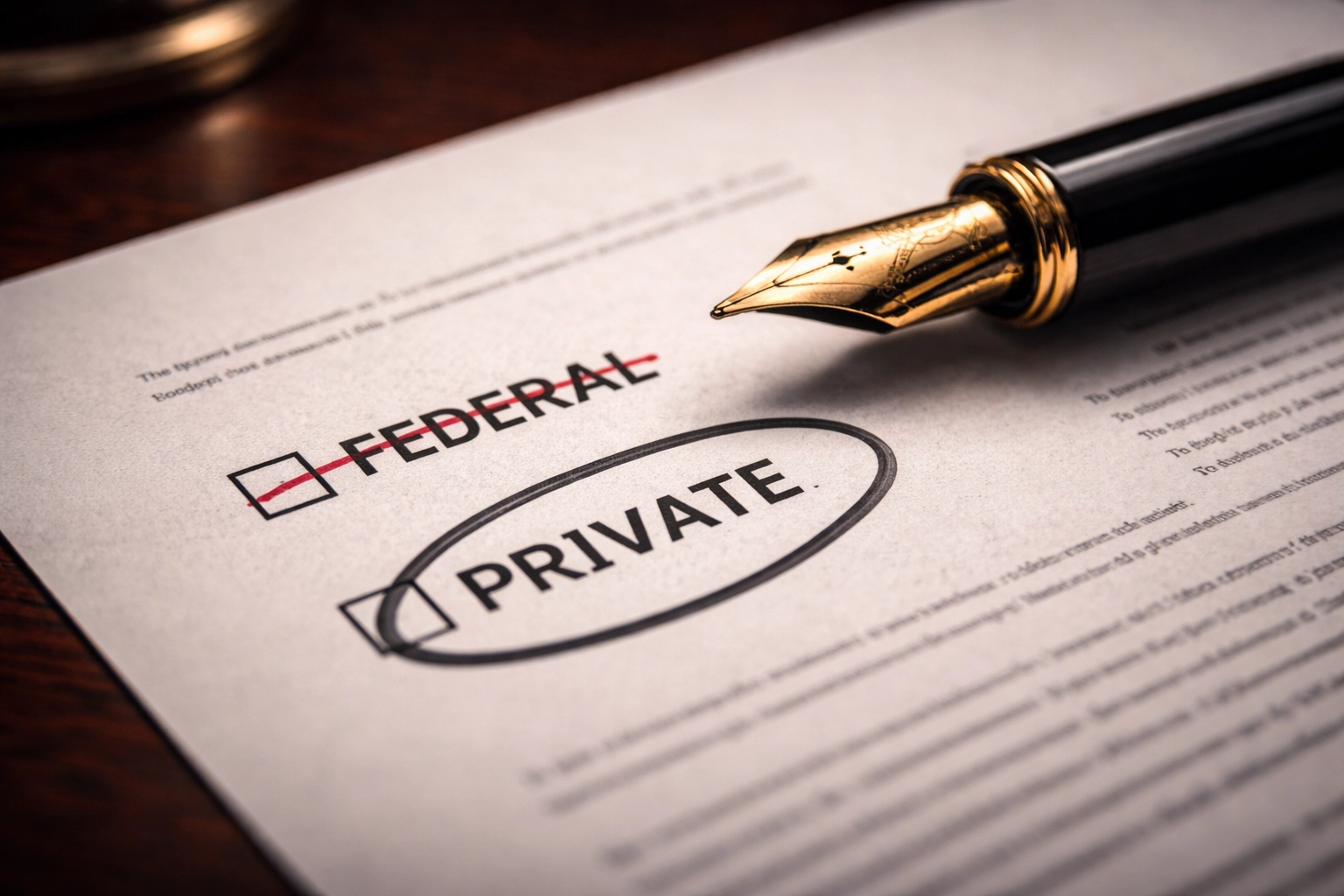
Refinancing federal student loans into private loans is an irreversible, one-way street. Once executed, you permanently lose forgiveness eligibility, Income-Driven Repayment (IDR) plans, and administrative forbearance. Never surrender these structured safety nets for a marginally lower interest rate without calculating the exact cost of the protections you destroy.
Quick Filter: Before you read further, ask yourself—
- Do you work for a government or nonprofit employer (or plan to)?
- Are your current loans federal Direct Loans?
- Could your income fluctuate in the next 5 years?
If you answered “Yes” to ANY of these: Stop. Refinancing will permanently eliminate your forgiveness eligibility. Do not proceed to refinancing research until you confirm your eligibility status.
Treating federal and private student loans as the same type of debt is a critical wealth-management error that will cost you tens of thousands of dollars. You must redefine your federal loans not just as debt, but as a heavily regulated social program equipped with emergency exit hatches.
Before you are tempted by a private lender offering a 4.5% interest rate to consolidate your 6.8% federal debt, you must understand the two fundamentally different ecosystems you are crossing between.
The Federal Ecosystem: Subsidized vs. Unsubsidized
If you filled out the FAFSA, you likely have federal loans. The U.S. Department of Education offers two main types of Direct Loans to undergraduate students:
- Direct Subsidized Loans: The government pays the interest on these loans while you are in school at least half-time, during the 6-month grace period, and during periods of deferment. It acts as an interest-free loan during vulnerable periods.
- Direct Unsubsidized Loans: You are responsible for paying the interest during all periods. If left unpaid while in school, it will be capitalized (added to the principal) when you enter repayment.
The Private Loan Trap: Rigid and Unforgiving
Private student loans are issued by banks and online lenders (like SoFi, Sallie Mae, or Discover). They are underwritten exactly like a mortgage. Private lenders are bound only by the contract you sign. If you lose your job or face a medical emergency, they are not legally obligated to pause your payments. If you default, they will sue you to garnish your wages.
| Feature | Federal Student Loans | Private Student Loans |
|---|---|---|
| Interest Rates | Fixed by Congress (Standard for all) | Variable or Fixed (Based on Credit) |
| Credit Check | None required for most Direct Loans | Strict Credit & Income Check required |
| Forgiveness | PSLF, Teacher Forgiveness, IDR Forgiveness | None (Zero path to forgiveness) |
| Hardship / Flexibility | Generous (IDR, Deferment, Forbearance) | Rigid (Contract-bound, severe default risk) |
The Mathematical Reality of Refinancing
Refinancing means taking out a brand-new private loan to pay off your federal loans to secure a lower interest rate. However, trading flexibility for a small margin is mathematically reckless if you qualify for forgiveness.
*Example assumes 10 years of qualifying PSLF payments with the remaining balance forgiven.
Saving $4,500 in interest over 10 years means nothing if you forfeit $35,000 in tax-free federal loan forgiveness. Do the math before you sign.
When Is Refinancing Actually Justified?
You should consider refinancing federal loans into private loans ONLY if you meet all of these conditions:
- High, Stable Income: You have a secure job and a robust 6-month emergency cash fund.
- Zero Public Service Intention: You work in the private sector and will absolutely never pursue Public Service Loan Forgiveness (PSLF).
- Strong Credit Score: You qualify for an undeniably lower interest rate that drastically reduces the loan’s lifetime cost.
- Fully Private Debt: Your existing loans are already private, meaning you have no federal protections to lose in the first place.
Frequently Asked Questions
Can I change a private loan back into a federal loan?
No. Once you refinance a federal loan into a private loan, the transformation is permanent. The federal government will not buy back the debt. It is a one-way transaction.
Do subsidized loans exist in the private market?
No. Private lenders operate for profit. They do not pause interest accrual while you are in school or unemployed. Interest begins ticking the moment the loan is disbursed and compounds relentlessly.
Conclusion: Know What You Hold
Do not let aggressive marketing from private refinancing companies cloud your judgment. A federal loan is a structured safety instrument; a private loan is a pure credit contract. Audit your loan servicers today, separate your federal and private balances, and never trade your government safety net for a tiny discount on interest unless you are mathematically certain you will never need it.
Next Step: The Golden Ticket
If you hold Federal Loans and work for a non-profit or the government, you might be sitting on a tax-free windfall. Read our next guide: The PSLF Golden Ticket: How to Get Your Loans Forgiven Tax-Free.