Backdoor Roth IRA Guide: How High Earners Bypass Limits
If you earn over $165,000 (Single) or $246,000 (Married), the IRS says you cannot contribute to a Roth IRA. But that’s not entirely true. You can’t walk through the front door, but the Backdoor Roth IRA is a perfectly legal, IRS-sanctioned side entrance. It allows you to move $7,500 (in 2026) into a tax-free account regardless of your income. The catch? If you do it wrong, you trigger the dreaded “Pro-Rata Rule” and face a massive tax bill. Here is the step-by-step execution guide to doing it safely.

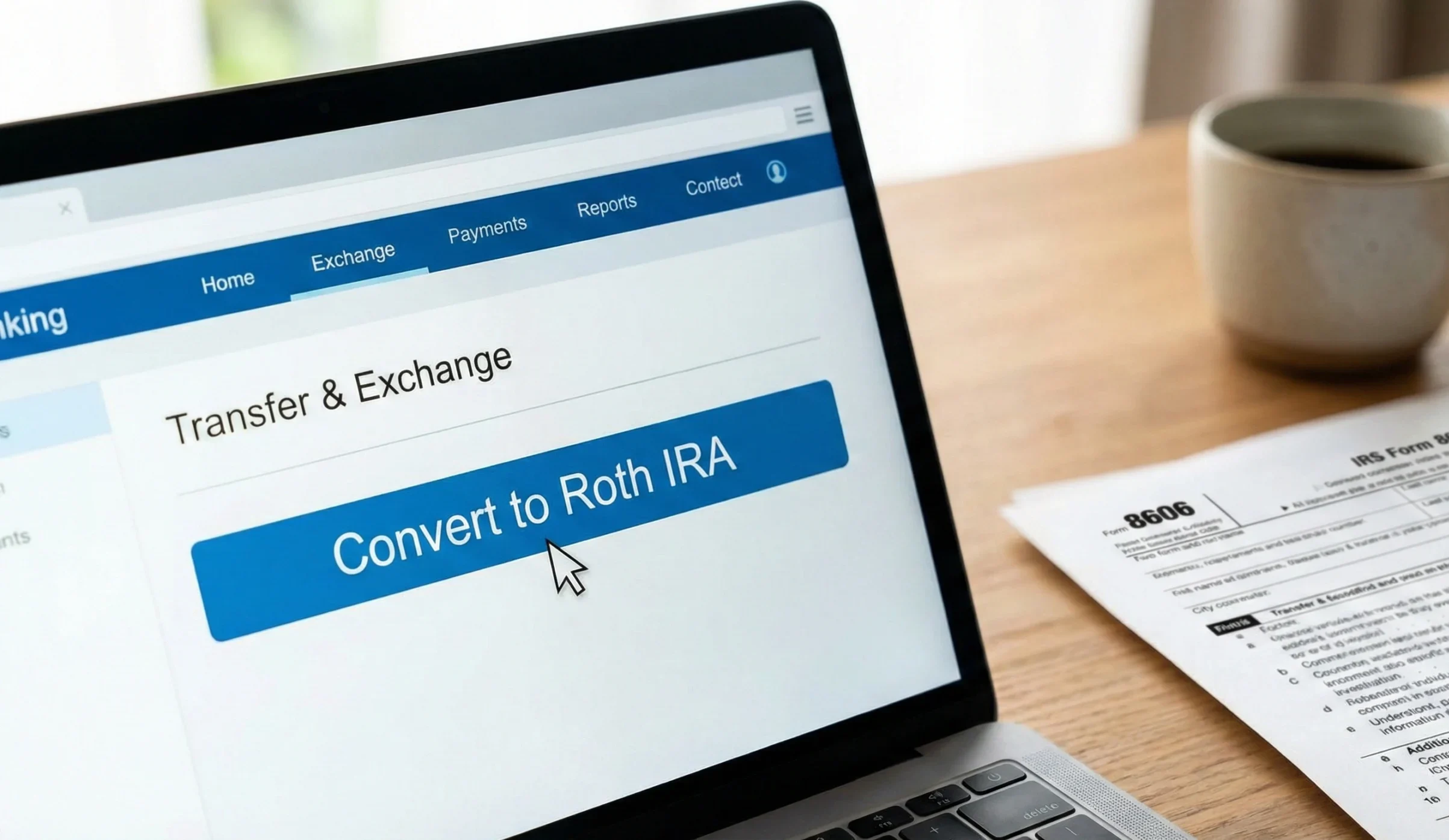
The Two-Step Dance: 1. Click ‘Convert’. 2. File Form 8606. Missing either step is costly.
1. The Execution: Two Steps to Tax-Free
It is simpler than it sounds. It’s just a transfer.
*Timing: Wait until the funds “settle” (usually 1-3 days) before converting. Do not invest the money while it is in the Traditional IRA; keep it in cash to avoid gains (which would be taxable).
2. WARNING: The Pro-Rata Rule
This is where 90% of people mess up. Read this carefully.
• Pre-Tax Money (Deductible): The dark coffee.
• After-Tax Money (Non-Deductible): The cream.
When you pour from the cup (convert to Roth), the IRS says you cannot just pour out the cream. You must pour out a mix proportional to the whole cup.
Result: If you have a large Rollover IRA (coffee), your Backdoor Roth (cream) will be mostly taxable.
- No Other IRAs: You have $0 in Traditional, SEP, or SIMPLE IRAs.
- 401(k) Only: You have millions in a 401(k) (401k balances are ignored by this rule).
- Spouse’s IRA: Your spouse has an IRA, but you don’t (IRAs are individual).
- Rollover IRA: You have an old 401(k) rolled into an IRA.
- SEP IRA: You have a SEP IRA from self-employment.
- Solution: Perform a “Reverse Rollover” to move these IRAs into a current 401(k) first.
3. The Critical Paperwork: Form 8606
Doing the trade is easy. Reporting it prevents double taxation.
- What is it? IRS Form 8606 tells the IRS, “Hey, I already paid tax on this $7,500 contribution. Don’t tax me again on the conversion.”
- When to file? You file it with your annual tax return (Form 1040).
- The Risk: If you forget this form, the IRS assumes your Traditional IRA contribution was Pre-Tax, and they will tax the conversion. You pay tax twice.