Trapped? upside down on car loan:
How to Escape in 3 Steps
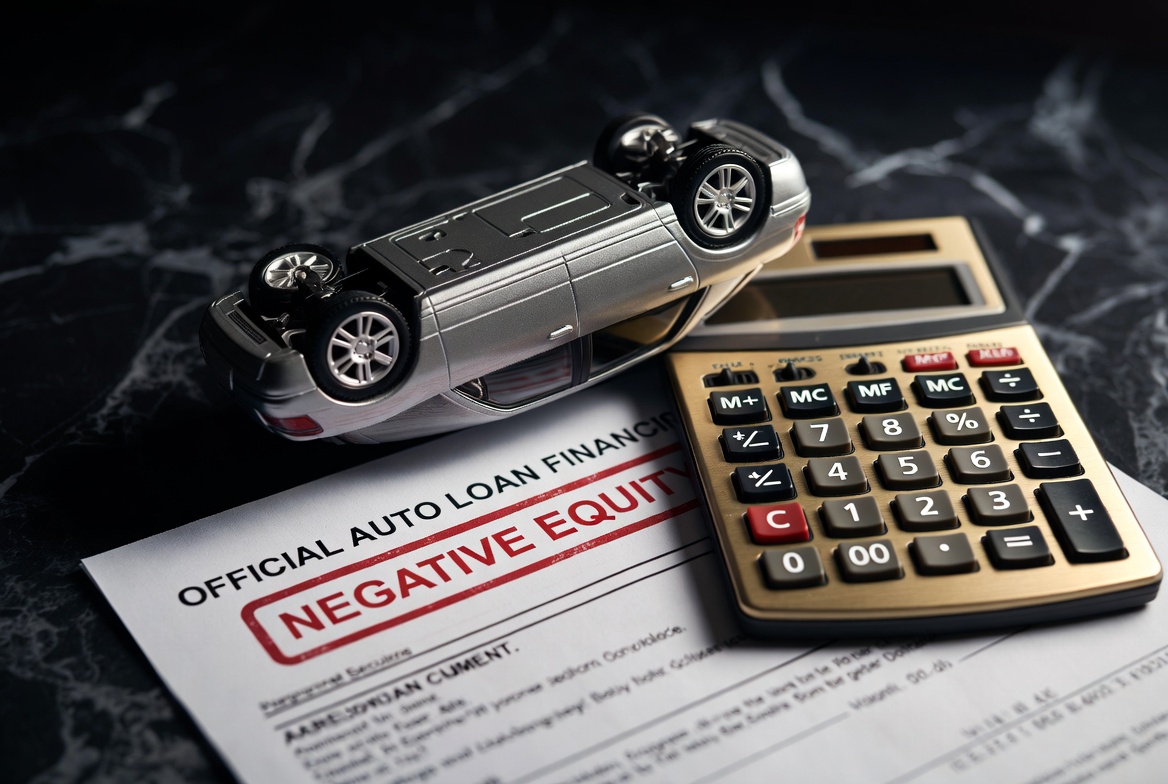
Being “upside down” on an auto loan—meaning you owe the bank more money than the vehicle is currently worth—is a mathematical quarantine. It completely paralyzes your financial liquidity. If you owe $30,000 on a car that can only be sold for $20,000, you hold $10,000 in “Negative Equity.” When consumers panic and try to trade in the vehicle to escape the massive monthly payment, dealerships execute their most predatory tactic: the Rollover. They simply take your dead $10,000 debt and bury it inside a brand new 84-month loan on a different car, guaranteeing you will pay interest on a vehicle you no longer even own. To break this toxic cycle, you cannot rely on dealership financing. Here is the CPA-verified blueprint on how to escape being upside down on car loan → safely, utilizing strategic lump-sum principal payments and personal bridge loans to release the title and restore your net worth.
This article is for you if:
✓Your loan balance is significantly higher than the actual Kelly Blue Book (KBB) value of your car
✓You want to sell or trade in the vehicle but cannot cover the negative equity gap in cash
✓A dealership has offered to “roll over” your old debt into a brand new car lease
RReviewed by BMT Credit Desk·
Sources: CFPB, FTC · Action Guide
THE TRAP
Over 100%
Loan-to-Value (LTV) ratio blocks refinancing
Auto Finance Analytics · Full sources → SEC 06
NEGATIVE EQUITY
Dead Debt
Debt unbacked by any physical asset
ROLLOVER
Toxic Move
Moving old debt onto a new car loan
Key Execution Facts
1Never roll negative equity into a new loan.
2Pay lump sums directly to the principal.
3Use a personal loan to cover the gap if selling.
Disclaimer: This article provides strategic debt recovery frameworks based on 2026 auto lending environments. Using an unsecured personal loan to pay off a secured auto loan carries different legal and credit implications. Always verify the exact payoff quote from your lender, as daily interest will change the final gap amount.
SEC 02PROBLEM— The Rollover Disaster
SECTION 02 — THE PROBLEM
You Cannot Finance Your Way Out of Debt
The primary cause of negative equity is a combination of zero down payments, predatory 84-month loan terms, and the immediate, brutal depreciation of the vehicle. If you finance $35,000 for a car with no money down, the moment you drive it off the lot, the market value drops to $28,000. You are instantly $7,000 upside down. Because your monthly payments on an 84-month term are so small, you are barely covering the interest. It will take five years before your loan balance finally drops below the actual value of the car.
The catastrophe happens when you try to exit the vehicle early. If you take that $7,000 of negative equity to a dealership and trade the car in for a $30,000 SUV, the dealer does not forgive the debt. They “roll it over.” You are now signing a $37,000 loan for a $30,000 car. You are paying 9% interest on a vehicle you traded in weeks ago. This creates a death spiral of compounding negative equity. The only mathematical way out is to aggressively attack the principal balance with external cash, or to hold the vehicle until the loan is completely amortized.
The Rollover Victim
Trades in a car with $8,000 of negative equity because they are bored of it
Accepts a new 84-month lease just to absorb the massive rolled-over debt
Pays high compound interest on a car sitting in a junkyard
Becomes “super upside down,” owing $50k on a new car worth only $35k
The Equity Defender
Refuses to trade in the vehicle, continuing to drive it to outlast the depreciation curve
Diverts $500 of monthly savings directly toward the loan’s principal balance
Takes out a small $5k personal loan to cover the gap, sells the car privately
Never finances negative equity into a new contract under any circumstances
INSURANCE WATCH OUT
The Total Loss Crisis. If you are $10,000 upside down and your car is totaled in a crash, your standard auto insurance will only pay the bank the actual cash value of the car. You will suddenly be left with no car, and a $10,000 bill due immediately to the bank. If you are upside down, you must carry GAP (Guaranteed Asset Protection) insurance.
SEC 03EVIDENCE— Data + Sources (E-E-A-T)
SECTION 03 — EVIDENCE & DATA
The Anatomy of a Rollover
How dealerships hide dead debt inside new car loans
Dead Debt$8,000
Structural loan financing errors
Market and interest factors
#1 CauseLong Terms
Source: Consumer Financial Protection Bureau (CFPB) Auto Finance Analytics, Federal Trade Commission (FTC)
SEC 04FAQ— Escape Mechanics
SECTION 04 — FAQ
Frequently Asked Questions
Yes, but it is complicated. The bank physically holds the title until the loan hits zero. If you owe $20k and a private buyer gives you $15k, the bank will refuse to release the title to the new buyer until you personally hand the bank the remaining $5k in cash. You must bridge that gap simultaneously to complete the sale.
Rarely. Most banks refuse to refinance a car if the Loan-to-Value (LTV) ratio is over 110% or 120%. If your negative equity puts your LTV at 140%, standard credit unions will instantly deny the refinance application because the unsecured risk is too high. You must aggressively pay down the principal first.
No. This is a common misconception. Guaranteed Asset Protection (GAP) insurance only triggers if the vehicle is completely destroyed in an accident or stolen. It does not cover voluntary sales, trade-ins, or repossessions. It is strictly disaster protection.
SEC 05DECISION— If/Then Framework
SECTION 05 — DECISION SUPPORT
The Negative Equity Escape Matrix
Use this tactical framework to select the exact financial maneuver required to sever the toxic debt.
Your Situation (IF)Recommendation (THEN)
The car runs perfectly fine, and you can comfortably afford the monthly payments
You are safe as long as you do not try to sell it
Do nothing. Keep driving the car for another 2 to 3 years. The amortization curve will eventually catch up, and the negative equity will naturally disappear.
You want to trade the car in, and the dealer offers to “roll over” the $6,000 gap
This guarantees you will be severely upside down on the next car
Refuse the deal. Never roll negative equity into a new loan. If you must trade it in, you must pay the $6,000 difference out of pocket in cash at the desk.
You owe $20k on a car worth $15k, and the monthly payments are bankrupting you
You must eliminate the asset to stop the monthly cash bleed
Take out a $5,000 unsecured personal loan from a credit union. Use the loan plus the $15k sale price to pay off the car. Your massive $700 car payment is now replaced by a tiny $150 personal loan payment.
You are upside down and you do not have GAP insurance coverage
One traffic accident could trigger immediate financial ruin
Call your auto insurance provider immediately and add GAP coverage. It usually costs less than $5 a month and prevents a catastrophic $10k liability if the car is totaled.
CPA COMMENT — 80% GUIDE
Do not make “extra payments” blindly. If you send the bank an extra $500, many systems automatically apply it as a pre-payment for next month’s interest, which does nothing to lower your negative equity. You must specifically instruct the bank to apply the extra $500 as a “Principal-Only Payment” to ensure it actively destroys the dead debt.
Consumer Financial Protection Bureau (CFPB) — Understanding Negative Equity and Auto Trade-Ins(2026) · consumerfinance.gov
2
Federal Trade Commission (FTC) — Buying and Owning a Car(2026) · consumer.ftc.gov
Sources are cited for informational purposes. Escaping negative equity via a personal loan converts secured debt into unsecured debt, which carries different interest rates. Always calculate the exact total cost before executing.
Do not make “extra payments” blindly. If you send the bank an extra $500, many systems automatically apply it as a pre-payment for next month’s interest, which does nothing to lower your negative equity. You must specifically instruct the bank to apply the extra $500 as a “Principal-Only Payment” to ensure it actively destroys the dead debt.