2026 Schedule A Itemized Deductions: Maximize Your Tax Refund
Executive Summary
Every tax season, millions of hardworking professionals leave thousands of dollars on the table by defaulting to the IRS Standard Deduction without running the math. Schedule A (Itemized Deductions) is the IRS tool designed to ensure you aren’t paying taxes on money that went toward essential living costs like medical care, state taxes, and mortgage interest.
For a typical 50-something professional earning $120,000 a year and managing a $600,000 401(k), taxes are likely your single largest annual expense. The IRS gives you a choice every year: take a flat, guaranteed write-off (the Standard Deduction) or manually add up your specific deductible expenses (Itemizing on Schedule A) and deduct whichever amount is larger. Since the Tax Cuts and Jobs Act (TCJA) temporarily doubled the standard deduction, nearly 90% of taxpayers stopped itemizing. However, as we look toward 2026 and shifting tax legislation, relying blindly on the standard deduction is a costly mistake.
Itemizing is not just for the ultra-wealthy. If you own a home, live in a state with high income or property taxes, or have a history of charitable giving, your combined expenses might easily clear the standard deduction hurdle. The secret to maximizing your tax refund isn’t just about keeping receipts; it’s about strategically timing your expenses. By understanding exactly how Schedule A is structured, you can actively group your deductions to legally slash your taxable income and keep more of your hard-earned salary in your pocket.
Structural Background

To use IRS Schedule A effectively, you must understand the four primary “buckets” of expenses that the government allows you to deduct from your Adjusted Gross Income (AGI).
The Four Pillars of Schedule A
1. Medical and Dental Expenses: You can deduct out-of-pocket medical costs, but only the amount that exceeds 7.5% of your AGI. If your AGI is $100,000, only medical expenses above $7,500 actually count toward your deduction.
2. State and Local Taxes (SALT): You can deduct the state income taxes (or sales taxes) and local property taxes you paid, but this bucket is strictly capped at $10,000 per year.
Interest and Charity
3. Home Mortgage Interest: For most homeowners, this is the biggest driver of Schedule A. You can deduct the interest paid on the first $750,000 of your mortgage debt (or $1 million if the loan originated before Dec 15, 2017).
4. Charitable Contributions: Cash donations to qualified 501(c)(3) charities can generally be deducted up to 60% of your AGI, and donations of appreciated stock are also highly tax-efficient.
Itemizing only makes mathematical sense if the sum of these four buckets is greater than your Standard Deduction. For a married couple filing jointly in recent years, the standard deduction hovers around $29,000. If your itemized deductions add up to $25,000, taking the standard deduction is still the better choice. Your goal is to find strategies to push those expenses over the hurdle rate.
Risk Layer
Because Schedule A directly reduces your taxable income, the IRS scrutinizes these deductions heavily. Careless reporting can lead to audited returns and disallowed deductions.
The “Shoebox” Record-Keeping Trap
The most common mistake DIY investors make is estimating their deductions without hard proof. If you claim $8,000 in charitable donations but cannot produce the official acknowledgement letters from the charities for any donation over $250, the IRS will deny the deduction entirely. A canceled check or credit card statement is not enough for larger donations. You must have the official receipt in hand before you file your tax return.
The SALT Cap Miscalculation
Many dual-income professionals living in high-tax states (like California, New York, or New Jersey) assume that paying $15,000 in property taxes and $10,000 in state income taxes gives them a $25,000 deduction. The current law severely restricts this. No matter how much you actually pay in state and local taxes, the maximum deduction you can claim on Schedule A is firmly capped at $10,000. Failing to account for this cap often leads taxpayers to think they will clear the standard deduction hurdle, only to realize at filing time that they fall short.
Strategic Framework
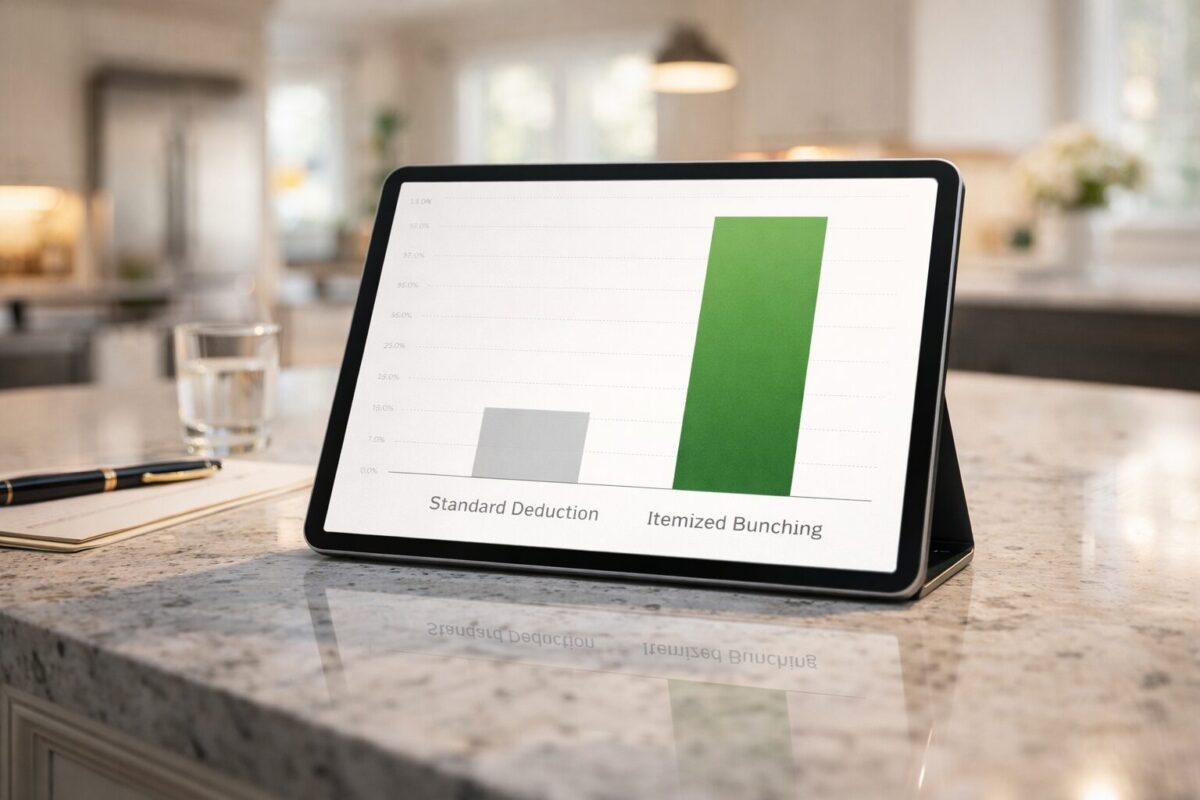
If your annual expenses are hovering just below the standard deduction limit (e.g., you naturally have $26,000 in deductions, but the standard is $29,000), you get zero extra benefit from your mortgage interest or charity. To fix this, savvy taxpayers use a legal timing maneuver called “Bunching.”
The “Bunching” Strategy in Action
Bunching involves accelerating or delaying deductible expenses so that two years’ worth of expenses fall into one single tax year. This intentionally spikes your Schedule A total for Year 1, allowing you to itemize and get a massive write-off. In Year 2, your expenses will naturally be very low, so you simply fall back on the standard deduction. You win in both years.
Example Scenario: Consider a married couple earning $150,000 with a $400,000 mortgage. They typically pay $14,000 in mortgage interest, hit the $10,000 SALT cap, and give $3,000 to charity. Their total is $27,000. Because the standard deduction is roughly $29,000, their $27,000 on Schedule A is completely wasted.
Instead, they use the Bunching strategy. In December of Year 1, they make their $3,000 charitable donation for the current year, AND they pre-pay their $3,000 donation for Year 2. They also schedule an expensive, out-of-pocket dental procedure for late December. Suddenly, their Year 1 itemized deductions spike to $34,000. They itemize in Year 1, saving thousands in taxes. In Year 2, they make no charitable donations, their itemized deductions drop to $24,000, and they happily take the $29,000 standard deduction. By simply shifting the timing of payments, they generated a larger overall tax shield.
| Tax Year | Without Strategy (Passive) | With “Bunching” Strategy (Active) |
|---|---|---|
| Year 1 | $27k Expenses → Takes $29k Standard | Spike Expenses to $34k → Takes $34k Itemized |
| Year 2 | $27k Expenses → Takes $29k Standard | Drop Expenses to $24k → Takes $29k Standard |
| Total 2-Yr Deduction | $58,000 total deduction | $63,000 total deduction (+$5,000 Extra Shield) |
This strategy is particularly powerful if you are planning to execute a Roth IRA conversion. By bunching your deductions into the exact same year you convert the funds, your artificially high Schedule A deductions can absorb the tax shock of the conversion income.
Frequently Asked Questions
Most standard closing costs (like appraisal fees, title insurance, and legal fees) are not deductible on Schedule A. However, “points” (prepaid mortgage interest) and a prorated share of property taxes paid at closing are generally deductible in the year you buy the home.
No. The IRS strictly prohibits this. If you are Married Filing Separately, you must both choose the same method. If one spouse chooses to itemize their deductions on Schedule A, the other spouse is forced to itemize as well, even if their deductions are zero.
If you pay your health insurance premiums with after-tax dollars out of your own pocket, yes, they count toward your medical expense bucket (subject to the 7.5% AGI floor). However, if your premiums are deducted from your paycheck pre-tax by your employer, you cannot deduct them again on Schedule A.
While paying off a mortgage eliminates your mortgage interest deduction, it is rarely a bad financial move. You are essentially saving $1 in interest to lose a 24-cent tax deduction. However, once that mortgage interest drops off your Schedule A, it becomes much harder to clear the standard deduction hurdle, making bunching strategies even more important for your charitable giving.
Series
Advanced Tax Deductions & Audit Defense
1 of 9 articles published
Data Sources & References
- [1] Internal Revenue Service (IRS) — About Schedule A (Form 1040), Itemized Deductions
- [2] Internal Revenue Service (IRS) — Tax Topic 501: Should I Itemize?