Huge Hospital Debt? Negotiate
Medical Bills Down by 50%
Medical debt is the fastest way to destroy a carefully planned budget. However, unlike a fixed mortgage or auto loan, a hospital bill is an illusion. Hospitals operate on highly inflated “Chargemaster” pricing, fully expecting insurance companies to negotiate those numbers down by 40% to 60%. If you are stuck paying out of pocket due to a high deductible or an out-of-network charge, you are being asked to pay a “sucker’s price.” By leveraging the threat of collections and offering a lump-sum cash settlement, you can legally force the billing department to slash your balance. Here is the exact, aggressive framework to protect your budget → and negotiate your medical debt down by half.
This article is for you if:
✓You received a medical bill that exceeds your emergency savings or monthly cash flow
✓You have the cash to pay, but refuse to pay the artificially inflated sticker price
✓You want the exact phone script to offer a 50% “paid-in-full” settlement
FReviewed by BMT Healthcare Finance Desk·
Sources: HFMA, CFPB · Action Guide
THE TARGET
50% Off
The standard settlement baseline for a lump-sum cash offer
Industry Settlement Averages · Full sources → SEC 06
LEVERAGE
Cash
Hospitals want money today
FIRST STEP
Itemize
Audit the CPT codes
Key Action Facts
1Never pay a “Summary Bill.” Demanding an itemized bill often triggers an automatic reduction of phantom charges.
2If a hospital sends your debt to collections, they only get pennies on the dollar. A 50% cash offer today is highly profitable for them.
3Putting a medical bill on a credit card instantly destroys your leverage and subjects you to 25% interest.
Disclaimer: This article provides negotiation frameworks for educational purposes. It is not legal or personalized financial advice. Settlement acceptance rates vary by hospital network and the age of the debt.
SEC 02PROBLEM— The Retail Illusion
SECTION 02 — THE PROBLEM
You Are Paying the “Sucker’s Rate”
The healthcare billing system is built on asymmetry. When you receive a bill for a $4,000 emergency room visit, the hospital does not actually expect to receive $4,000. If an insurance company were paying that exact same bill, they would invoke their negotiated rates and remit only $1,500.
However, if you are uninsured, or if the bill represents your massive $5,000 high-deductible, the hospital sends you the raw “Chargemaster” price. If you panic and write a check from your savings account for the full amount, you are artificially subsidizing the hospital’s losses. Your greatest weapon in this fight is time and cash liquidity. Hospitals know that if the bill goes unpaid and gets sold to a collection agency, they will recover almost nothing.
The Passive Patient
Accepts the “Summary Bill” total without questioning it
Puts a $3,000 medical bill on a Visa to earn points
Signs up for a CareCredit card, risking deferred interest traps
Pays 100% of the Chargemaster rate, draining their budget
The Tactical Negotiator
Demands an itemized bill with CPT codes to audit for upcoding
Calls the billing department and offers a 40% lump-sum cash payoff
Requires the hospital to send the settlement agreement in writing
Forces a 0% interest payment plan if cash isn’t available
FINANCIAL WATCH OUT
The Credit Card Trap. Hospitals will aggressively push you to put the bill on a credit card. Do not do it. Medical debt has special federal protections—it doesn’t hit your credit report for a year, and it doesn’t accrue 25% compounding interest. The second you put it on a credit card, it transforms into regular consumer debt. You lose all your leverage to negotiate and all your legal protections.
SEC 03EVIDENCE— Data + Sources (E-E-A-T)
SECTION 03 — EVIDENCE & DATA
The Economics of a 50% Cut
Value of the exact same medical procedure based on the payer
Your TargetInsurance Rate
Total Saved-$2,250
Source: Healthcare Financial Management Association (HFMA), CFPB Medical Debt Analytics
SEC 04FAQ— Negotiation Scripts
SECTION 04 — FAQ
Frequently Asked Questions
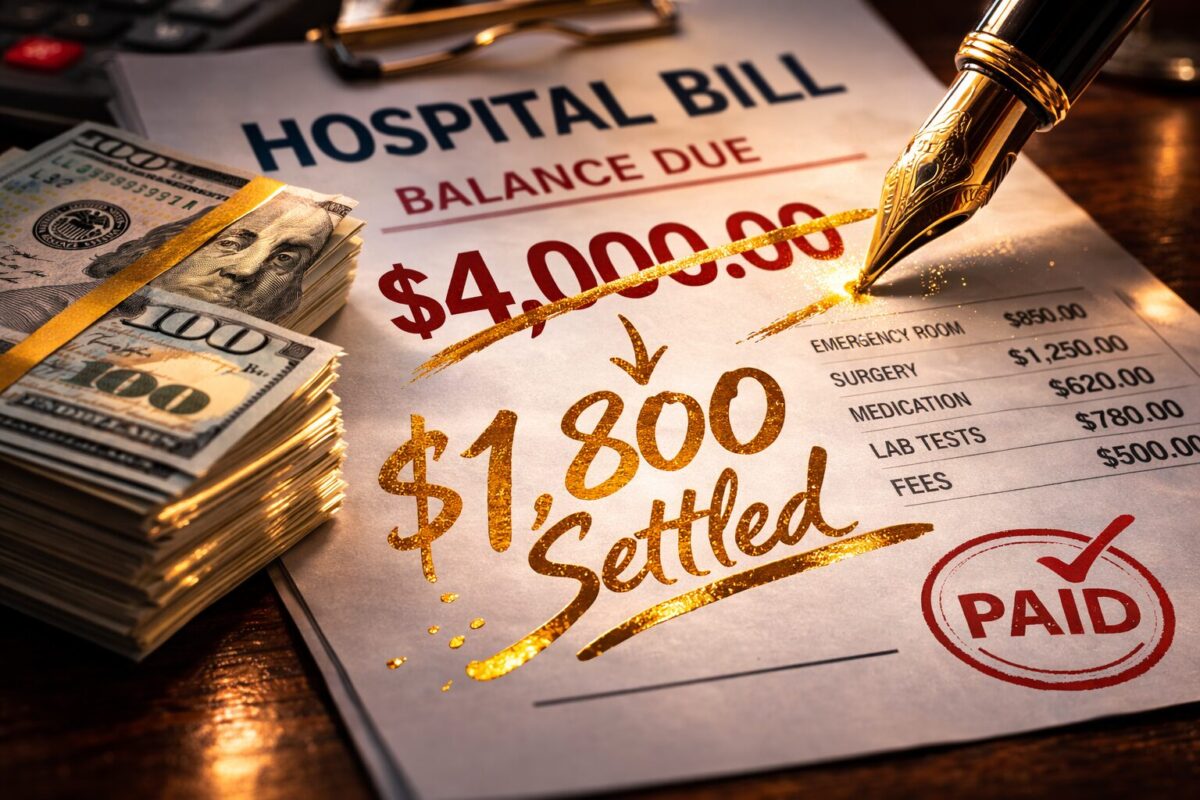
Do not ask for a discount; make a business offer. Say: “I received a bill for $4,000. I cannot afford this, but I want to resolve the account today. I have $1,800 in cash available right now. If you accept this as payment in full, I will give you the card number immediately.” If the Tier 1 rep says no, ask for a supervisor.
Yes! Non-profit hospitals are legally required to offer Financial Assistance Policies (FAP). Many hospitals offer sliding-scale discounts (e.g., 50% to 80% off) for individuals making up to 300% or 400% of the Federal Poverty Level. This means a family of four earning $100,000 might still legally qualify for massive bill reductions.
If they refuse a settlement, or if you lack the cash, demand an interest-free payment plan. Hospitals act as their own 0% lenders. Say: “I can commit to paying $50 a month.” As long as you make consistent monthly payments, they will almost never send the account to collections.
SEC 05DECISION— If/Then Framework
SECTION 05 — DECISION SUPPORT
The Bill Defense Matrix
Use this action framework to systematically dismantle a hospital bill the moment it arrives in your mailbox.
Your Situation (IF)Recommendation (THEN)
You receive a bill that just says “Total Due: $4,000”
You are looking at a deceptive summary bill
Call and Demand a Full Itemized Bill with CPT Codes
Your income is under 400% of the poverty line
You likely qualify for IRS-mandated hospital aid
Download and File a “Charity Care” Application
You have cash and the bill is accurate, but overpriced
You hold the leverage of immediate liquidity
Offer a 40% to 50% Lump-Sum Cash Settlement
The hospital agrees to settle the account for $1,500
A verbal agreement is completely worthless
Get “Paid in Full” Agreement in Writing Before Paying
ACTION COMMENT — 80% GUIDE
Billing departments are trained to say “no” to your first settlement offer. This is a standard negotiation dance. If they reject your 50% offer, hang up, call back two days later, and speak to a different representative. Often, getting a discount is simply a matter of finding a rep who is motivated to close files that day. Persistence is what saves you thousands of dollars.
Billing departments are trained to say “no” to your first settlement offer. This is a standard negotiation dance. If they reject your 50% offer, hang up, call back two days later, and speak to a different representative. Often, getting a discount is simply a matter of finding a rep who is motivated to close files that day. Persistence is what saves you thousands of dollars.