New Rules: How Unpaid Medical Bills
Actually Affect Your Credit Score
For decades, a single unpaid hospital bill could ruin your credit score, preventing you from buying a house or getting a car loan. Recognizing that medical debt is rarely a choice, the Consumer Financial Protection Bureau (CFPB) and the three major credit bureaus overhauled the reporting system. Under the New Medical Debt Rules, the vast majority of medical collections are now blocked from appearing on your credit report. Before you drain your savings or use a medical credit card → out of fear, you must understand these federal protections.
This article is for you if:
✓You have an unpaid medical bill and are terrified it will destroy your FICO score
✓You recently paid off an old medical collection and want it removed from your report
✓You are dealing with a medical bill that was originally under $500
CReviewed by BMT Credit Analysis Desk·
Sources: CFPB, Equifax, Experian · For informational purposes only
THE SAFE ZONE
< $500
Initial medical debts under this amount will not appear on your credit report
Bureau Guidelines 2026 · Full sources → SEC 06
GRACE PERIOD
1 Year
Time to negotiate
PAID DEBT
Deleted
Eligible for removal
The 3 Golden Rules
1Under $500 is invisible: Collections with an initial balance under $500 are not reported.
2Paid equals deleted: Unlike credit cards, paid medical debt is wiped from your history.
3The 1-Year Shield: Unpaid bills over $500 won’t show up for a full 365 days.
Disclaimer: This article is for educational purposes. Credit reporting rules are subject to CFPB regulatory updates. Always review your official credit reports at AnnualCreditReport.com to verify your specific data.
SEC 02PROBLEM— The Fear-Based Payment Trap
SECTION 02 — THE PROBLEM
Stop Using Credit Cards for Hospital Bills
The greatest danger you face isn’t the hospital bill itself; it is reacting to the bill out of fear. Debt collectors use the threat of a ruined credit score to pressure you into paying bills you cannot afford or bills that contain massive overcharges. Because consumers don’t know the new rules, they panic and put a $400 hospital bill on their standard Visa or Mastercard.
This is a strategic mistake. By doing this, you convert medical debt into standard consumer debt. You effectively forfeit the 1-year grace period and the $500 reporting exemption, as the credit card company treats it like any other retail purchase. If you miss a credit card payment, it can damage your score after just 30 days.
The Old System (Pre-2023)
Debt hit your credit report after 6 months
Even a $50 unpaid lab fee would sink your score
Paying it off left a “Paid Collection” mark for 7 years
Ruined your chances of getting a mortgage
The New Protections (Current)
You have a full 365-day shield to negotiate or appeal
Initial bills under $500 are generally invisible to bureaus
Paid medical debt is eligible for complete deletion
Newer FICO models penalize remaining medical debt much less
CREDIT WATCH OUT
Consolidation Loans. Similar to credit cards, taking out a personal loan to pay off hospital debt converts it to standard debt. If you fall on hard times and cannot pay the personal loan, your credit score will plummet, whereas the original hospital bill (if kept with the hospital) offered far more flexibility and reporting shields.
SEC 03EVIDENCE— Data + Sources (E-E-A-T)
SECTION 03 — EVIDENCE & DATA
The Impact of the Rules
Days before an unpaid debt can be reported to Credit Bureaus
Your Advantage1 Full Year
Debt under $500 wiped from reports nationwide
Debt over $500 (Subject to 1-year waiting period)
CFPB ImpactMassive Relief
Source: CFPB Medical Debt Reporting Studies, Equifax/Experian/TransUnion Joint Policy
SEC 04FAQ— People Also Ask
SECTION 04 — FAQ
Frequently Asked Questions
Not exactly. The $500 exemption applies to the initial reported balance when the account is sent to collections. If a $600 bill goes to collections and is reported, paying off $101 to bring the balance to $499 does not automatically trigger its removal. To protect your credit, you must negotiate the balance down before the 1-year grace period expires and it gets reported.
Under the new rules, paid medical debt is eligible for removal. If it is still showing, you should file a dispute with Equifax, Experian, and TransUnion stating: “This is a paid medical collection and should be removed under current reporting guidelines.” The credit bureaus typically process these disputes and update your file within 30 to 45 days.
Typically, no. Most hospitals are not in the business of credit reporting. They usually hold the debt internally for a period, then eventually sell or assign it to a third-party Collection Agency. It is generally the Collection Agency that reports it to your credit file. This is why you have so much time (the 1-year grace period) to resolve it with the hospital directly.
SEC 05DECISION— If/Then Framework
SECTION 05 — DECISION SUPPORT
The Credit Protection Matrix
Use this triage guide to handle medical debt without destroying your FICO score.
Your Situation (IF)Recommendation (THEN)
The initial total bill is $450 and you cannot pay it
Under the $500 reporting threshold
Relax. It should not hit your credit.
The bill is $5,000 and it has been 3 months
You are within the 1-year protective grace period
Apply for Charity Care / Negotiate safely
The debt is on your report, but you just paid it off
Paid medical debt cannot remain on the report
Wait 30-45 Days / File a Dispute if needed
A debt collector pressures you to put it on a credit card
This converts safe medical debt to dangerous consumer debt
Refuse. Keep it as Medical Debt.
EDITOR’S COMMENT — 80% GUIDE
The most important takeaway: Do not let debt collectors rush you. They use urgency as a weapon. If a hospital bill is $1,200, you have a full year to request an itemized bill, apply for financial assistance, and negotiate a settlement before your credit score is in any danger whatsoever. Take a breath, and use the rules to your advantage.
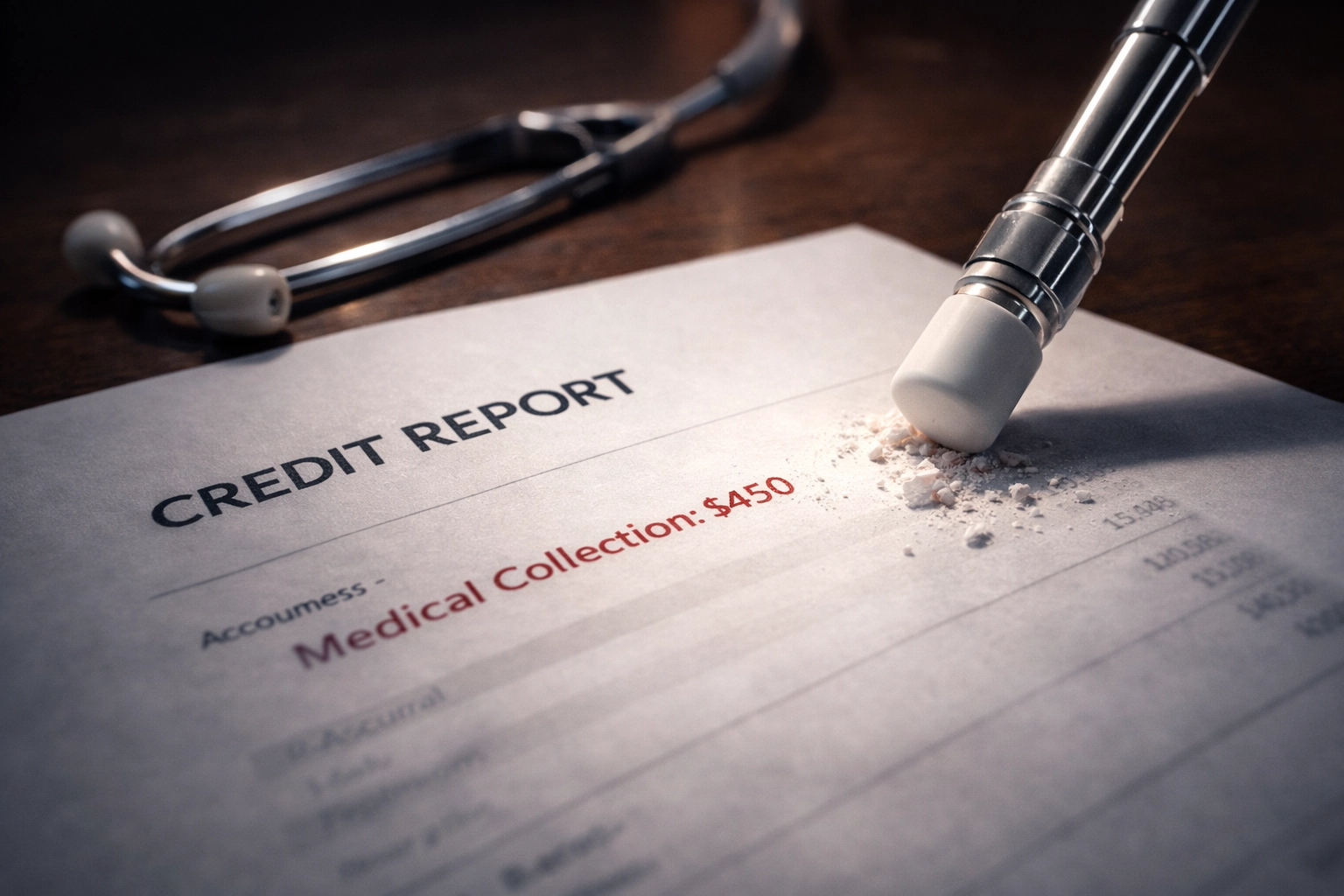
The most important takeaway: Do not let debt collectors rush you. They use urgency as a weapon. If a hospital bill is $1,200, you have a full year to request an itemized bill, apply for financial assistance, and negotiate a settlement before your credit score is in any danger whatsoever. Take a breath, and use the rules to your advantage.