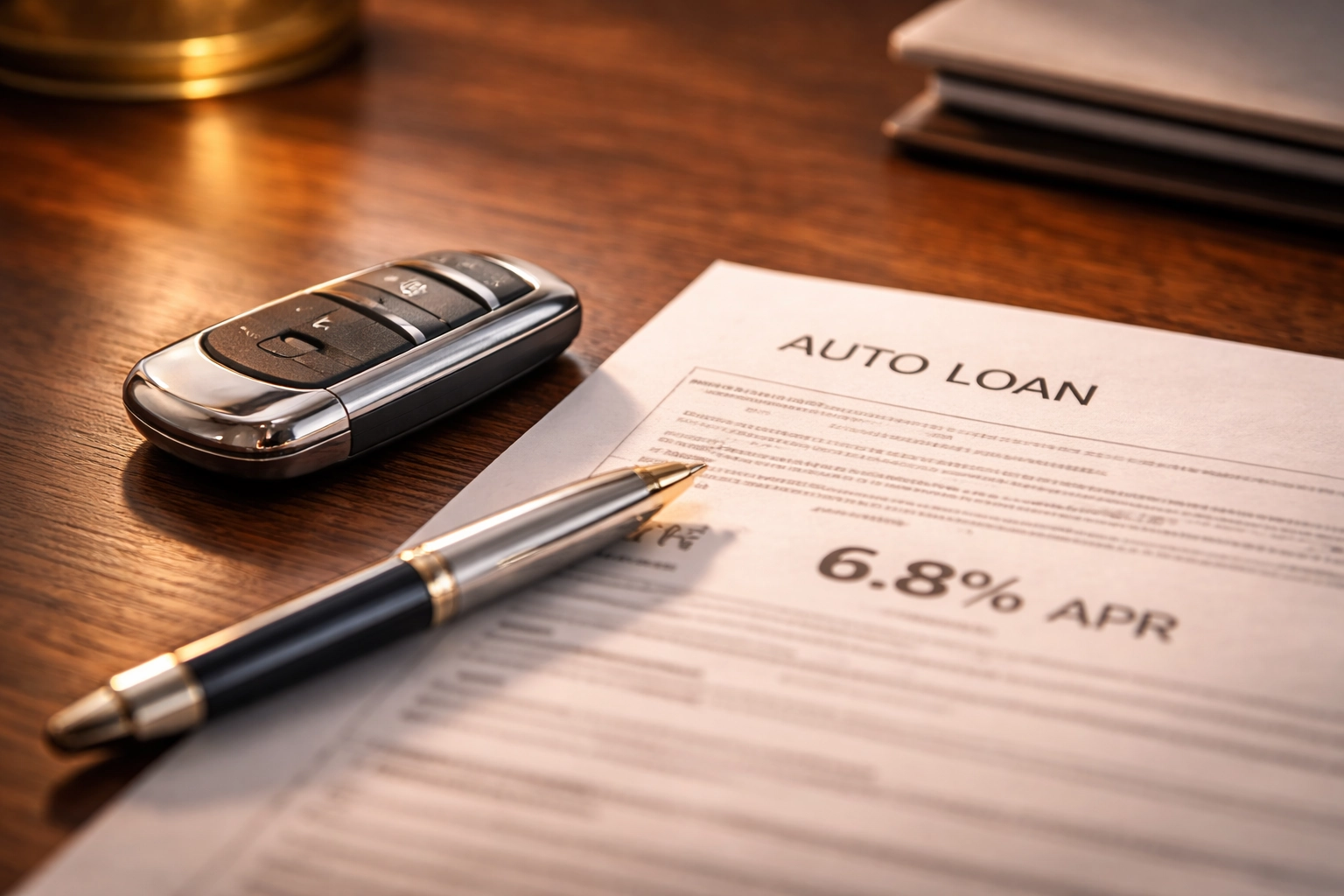
As the automotive finance market adjusts to early 2026 economic conditions, new data reveals a shifting landscape for car buyers. Recent Edmunds and Experian snapshots show the average new-car loan interest rate hovering at 6.8% APR, while used-car rates have eased to 10.5% APR. This update analyzes the current credit-tier breakdowns, the reality of the $745 average monthly payment, and what these financing costs mean for consumer liquidity and smart spending strategies.
What Happened (Q1 2026 Auto Loan Snapshot)
Entering 2026, the Federal Reserve’s consumer credit metrics (G.19) indicate that auto loan rates have broadly stabilized after peaking above 8% at commercial banks in previous quarters. According to January 2026 Edmunds data reported by NerdWallet, the average APR for a new vehicle sits at 6.8%, closely mirroring Experian’s earlier 6.73% baseline. Conversely, the used-car market has seen borrowing costs decline to an average of 10.5%, providing some relief from the near-12% averages seen a year prior.
- New car rates steady: The average interest rate for new vehicle financing is 6.8% APR in early 2026.
- Used car rates ease: Borrowing costs for used vehicles have dropped to an average of 10.5% APR.
- Monthly payment burden: The average monthly payment remains elevated at $745 for new cars and $521 for used.
- Credit score dictates cost: Super-prime borrowers secure rates near 5.18%, while deep-subprime rates exceed 15.8%.
- First Trust Global Auto ETF (CARZ) 58.20 (+0.6%) ▲
- US 5Y Treasury Yield (Auto Proxy) 3.98% (-4 bps) ▼
- Consumer Discretionary (XLY) 185.10 (+0.5%) ▲
APR Trends: New vs. Used Vehicle Financing
The spread between new and used auto loan rates remains a defining feature of the 2026 financing landscape. While manufacturer incentives and subvented financing often artificially lower new-car APRs, used-car buyers are fully exposed to prevailing market rates. Despite this, the used-car APR has meaningfully compressed from its 11.87% peak to a more manageable 10.5%.
The Cash Flow Reality: Monthly Payments
Even as interest rates show signs of stabilization, high transaction prices continue to stretch consumer budgets. The typical monthly commitment for a new vehicle sits at a hefty $745, acting as a significant drain on monthly cash flow. Opting for a used vehicle reduces this burden to $521, saving consumers nearly $2,700 annually in cash outflows.
Forward Outlook & Financing Scenarios
- Trigger: The Federal Reserve executes further rate cuts, pushing 60-month commercial bank auto rates below 7.0%.
- Strategy: Dealerships aggressively deploy 0% to 3.9% promotional APRs to clear aging 2025 and early 2026 inventory.
- Market Impact: Consumer monthly payments for new cars drop closer to the $650 range, stimulating retail automotive sales.
- Trigger: Sticky inflation halts rate cuts, keeping deep-subprime (FICO 300–500) borrowing costs trapped above 15.8%.
- Strategy: Lenders tighten underwriting standards and demand higher down payments to mitigate risk.
- Market Impact: Delinquencies rise in the used-car sector, forcing buyers into longer 72- or 84-month loan terms just to afford the $521 monthly payment.