Hobby vs Business: The IRS “3-Year Profit” Rule Explained
Did you buy $5,000 worth of camera gear for your “photography business” but only made $200 this year? If you claim a $4,800 loss to lower your W-2 taxes, the IRS might stop you. The IRS distinguishes between a Profit-Seeking Business and a Personal Hobby. Since the tax law changes (TCJA), getting reclassified as a “Hobby” is financially devastating. Here is the 3-year test you must pass to keep your deductions safe.

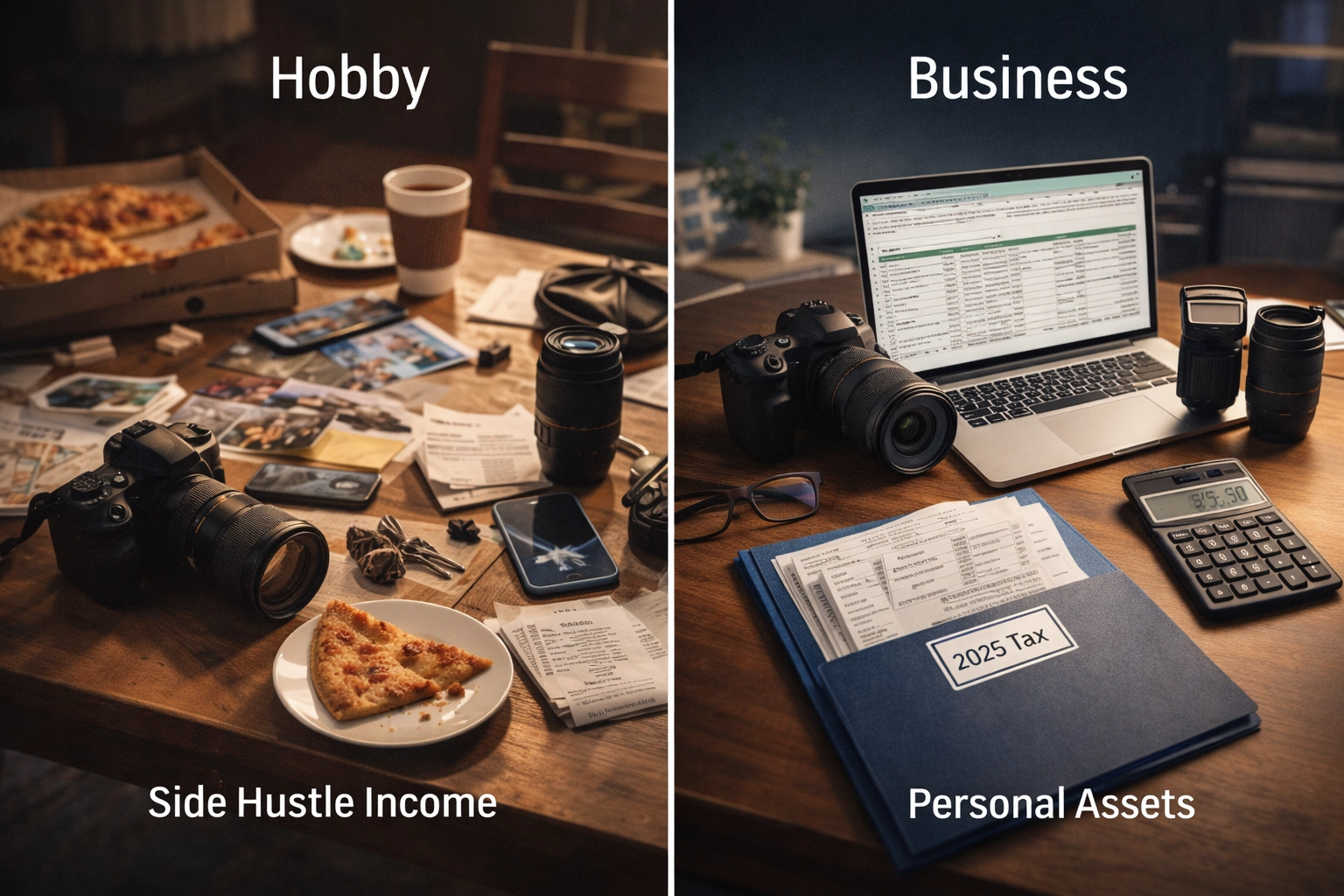
The Eye of the Auditor: The IRS looks at your behavior. A messy, unorganized operation (Left) looks like a Hobby. A clean desk with records, receipts, and a business plan (Right) proves you are running a Business.
Image Source: bestmoneytip.com
1. Why It Matters: The “Zero Deduction” Nightmare
Before we talk about the rules, look at the math. Many freelancers think, “If I’m a hobby, I just break even.” Wrong.
2. The “3-of-5” Safe Harbor Rule
The IRS uses a simple objective test first.
If you have made a profit in at least 3 of the last 5 tax years (including the current year), the IRS presumes you are a legitimate business.
*Note: For horse racing/breeding, the rule is 2 out of 7 years.
3. Failing the Test? Use the “9 Factors” Defense
What if you’ve lost money for 4 years straight? Are you doomed? Not necessarily. You must prove your “Profit Motive” using the IRS 9-Point Checklist.
- 1. Records: Do you carry on activity in a businesslike manner? (e.g., Separate bank account, Ledger).
- 2. Expertise: Did you study or hire experts to help you make money?
- 3. Time & Effort: Do you spend significant time trying to grow?
- 4. Pleasure: Is the activity purely for fun? (e.g., Yacht racing vs. Commercial fishing).
- 5. Financial Status: Do you have a rich W-2 job and use this loss just to offset taxes?
- 6. History of Income: Have you ever made money?
4. Audit-Proofing Your Loss
If you are running a loss this year, take these actions today to prove intent.