Schedule C for Beginners: Filing Your Side Hustle Taxes (Line-by-Line)
If you earned money without a boss, you are a “Sole Proprietor.” This means you must attach a special report card to your tax return: Schedule C (Profit or Loss from Business). This form is where the magic happens. It is where you tell the IRS, “Yes, I made $10,000 (Revenue), but I spent $3,000 to earn it (Expenses), so please only tax me on $7,000 (Profit).” Here is a plain-English guide to filling it out without triggering an audit.

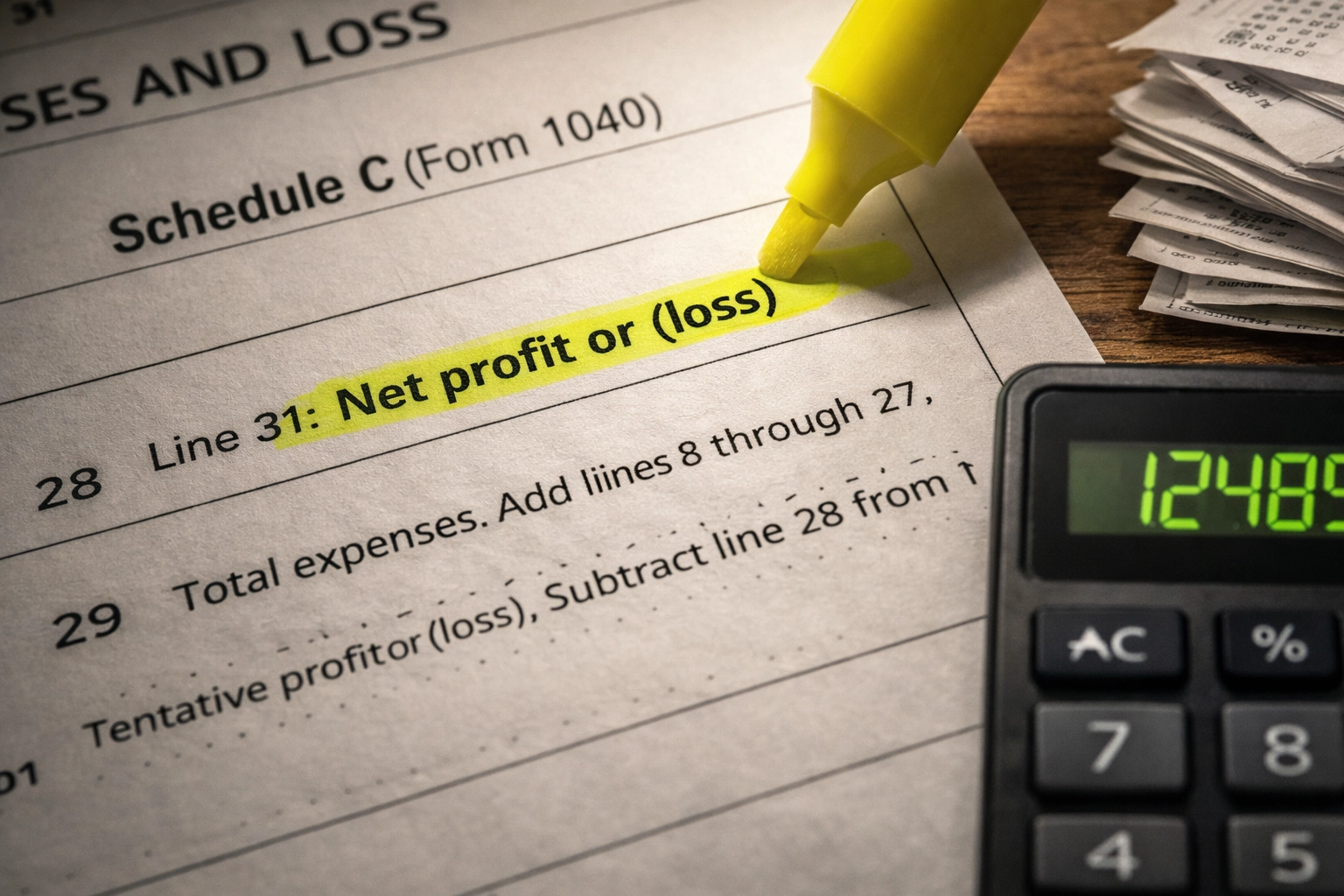
The Bottom Line: Line 31 (Net Profit) is the most important number on this form. It equals Income minus Expenses. This highlighted number is what you actually pay taxes on.
Image Source: bestmoneytip.com
1. The Anatomy: How the Math Works
Think of Schedule C as a funnel. Money pours in at the top, expenses filter it out, and taxable profit drips out the bottom.
Everything you earned ($10,000)
Everything you spent (-$3,000)
Taxable Amount ($7,000)
2. Part I: Income (The “Line 1” Rule)
Line 1 (Gross receipts or sales) is where you list every penny.
YES. The IRS requires you to report all worldwide income. If you get audited and they see Venmo deposits that aren’t on Line 1, you are in trouble.
- Add up: 1099-NEC forms + 1099-K forms + Cash + Checks + Venmo/Zelle payments.
- Enter Total: Put this sum on Line 1.
3. Part II: Expenses (Where to Put What)
This is where you lower your taxes. But you must categorize correctly.
| Line # | Category | Common Examples |
|---|---|---|
| Line 8 | Advertising | Facebook Ads, Business Cards, Website Hosting. |
| Line 9 | Car & Truck | Standard Mileage Deduction (See Article 702). |
| Line 10 | Commissions | Upwork/Fiverr Fees (Platform fees go here). |
| Line 17 | Legal/Prof | Accountant fees, TurboTax cost, Lawyer. |
| Line 18 | Office Exp | Postage, Printer ink, Software subscriptions. |
| Line 30 | Home Office | Simplified Method ($5/sq ft). (See Article 703). |
4. Three Red Flags to Avoid
The IRS computer system scans for anomalies. Don’t look suspicious.
5. What Happens to Line 31?
Once you calculate your Net Profit on Line 31, it travels to two other forms.
- Path A (Income Tax): It moves to Schedule 1, then to Form 1040. It gets added to your W-2 wages to determine your Income Tax.
- Path B (SE Tax): It moves to Schedule SE. This is where the 15.3% Self-Employment Tax is calculated.
*If Line 31 is a Loss (Negative number), it reduces your other taxable income. But be careful: if you claim losses for 3 years in a row, the IRS may classify your business as a “Hobby.”