Home Office Deduction: The “Simplified Method” for Renters
Do you work from your apartment? If you are a freelancer or side hustler, a portion of your rent, electricity, and internet bills could be tax-deductible. Many people are scared to claim this because they fear an audit. But the IRS offers a “Simplified Method”—a safe harbor rule that allows you to deduct $5 per square foot without receipts. Here is how to turn your desk into a tax shield (and the profit rules you must know).

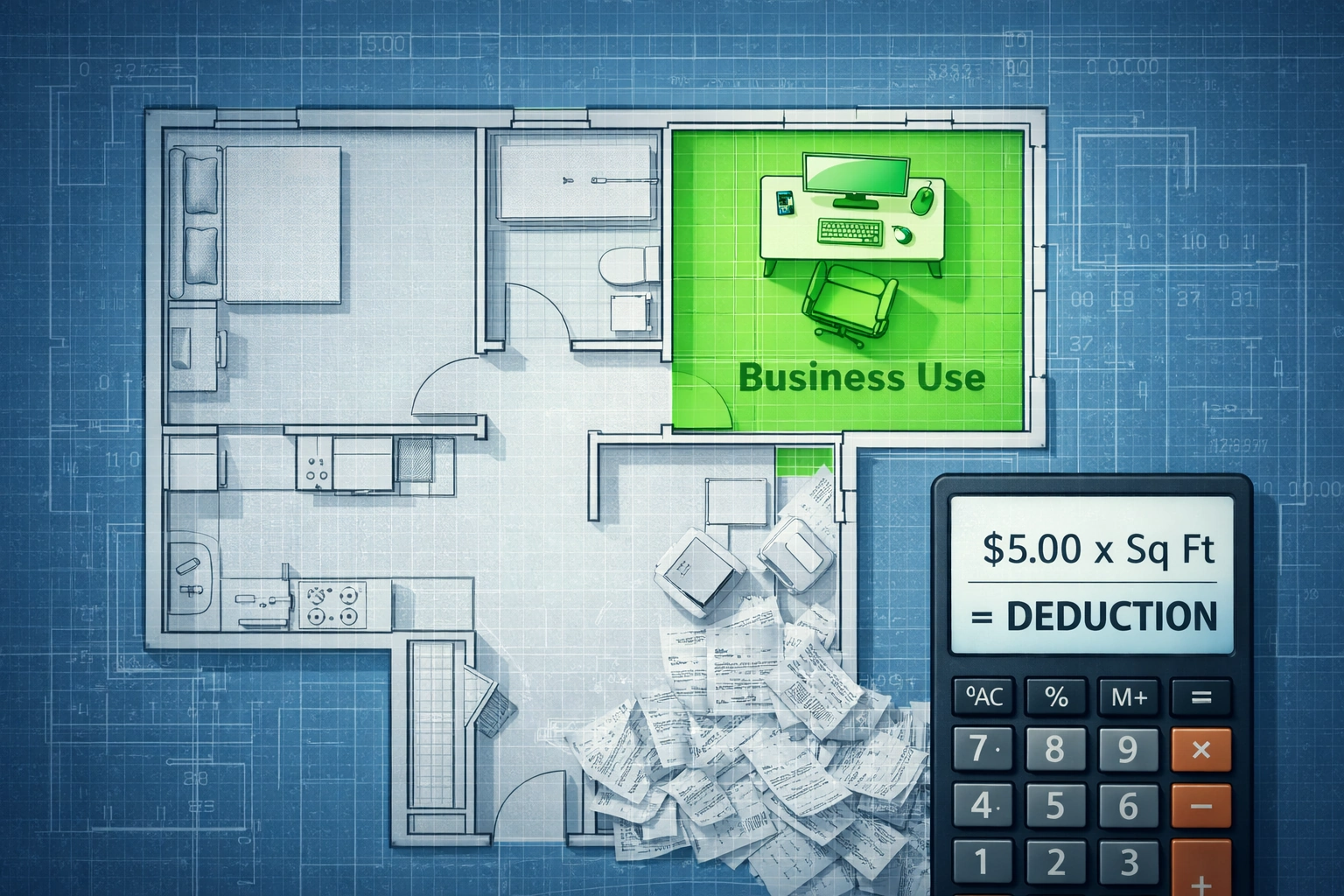
The “Exclusive Use” Rule: To claim the deduction, your office (Green Zone) must be a distinct area used 100% for business. The rest of the apartment (Gray Zone) where you eat or sleep is personal and cannot be counted.
Image Source: bestmoneytip.com
1. The Test: “Exclusive & Regular Use”
Before you calculate, you must pass the test. The IRS is strict about this.
- A spare bedroom used only as an office.
- A corner of your living room with a desk, used only for work (no TV watching).
- A detached garage studio.
- The dining room table (you eat there too).
- A desk in the bedroom that you also use for gaming/Netflix.
- Working from the couch.
2. Visualizing Your “Business Percentage”
If your apartment is 1,000 sq ft, and your office is 100 sq ft, your “Business Use Percentage” is 10%. This percentage is the key to the Actual Expenses Method.
3. Method A: The Simplified Option (Safe & Easy)
This is the “No Receipt” method. The IRS gives you a standard rate.
Square Footage × $5 = Deduction
(Max 300 sq ft or $1,500)
Scenario: You earned $1,000 from freelancing. Your home office deduction calculation is $1,500.
Result: Your deduction is capped at $1,000. You pay $0 tax, but you cannot carry over the extra $500 loss with the Simplified Method.
4. Method B: Actual Expenses (For Renters in Expensive Cities)
If you live in NYC or SF where rent is $4,000/month, the Simplified Method ($1,500 max) is too low. You should use Actual Expenses.
| Expense Item | Monthly Cost | Deduction (10% Biz Use) |
|---|---|---|
| Rent | $3,000 | $300 |
| Electricity/Heat | $150 | $15 |
| Internet | $80 | $8 |
| Total Monthly | $3,230 | $323 |
| Total Yearly | $38,760 | $3,876 |
*Result: $3,876 (Actual) > $600 (Simplified). Winner: Actual.
5. Which Method Should You Choose?
| Scenario | Winner |
|---|---|
| Small Space / Low Rent (e.g., $1,000 rent, 100 sq ft office) |
Simplified Method (Less paperwork, similar result) |
| Large Space / High Rent (e.g., $3,000 rent, 200 sq ft office) |
Actual Expenses (Math wins, keep receipts) |
| Audit Phobia | Simplified Method (IRS rarely questions this) |
6. Proof: Take a Picture Today
If the IRS audits you, they will ask: “Was that room really exclusively for business?”