Debt Settlement vs Consolidation: One Saves You, One Ruins You
If you are drowning in debt, you will see ads promising to “cut your debt in half.” Beware. There is a massive difference between Debt Consolidation (a new loan to pay off old ones) and Debt Settlement (forcing creditors to take less money). One preserves your credit score; the other destroys it for 7 years. Here is the brutal truth about the “Debt Relief” industry that they don’t want you to read in the fine print.

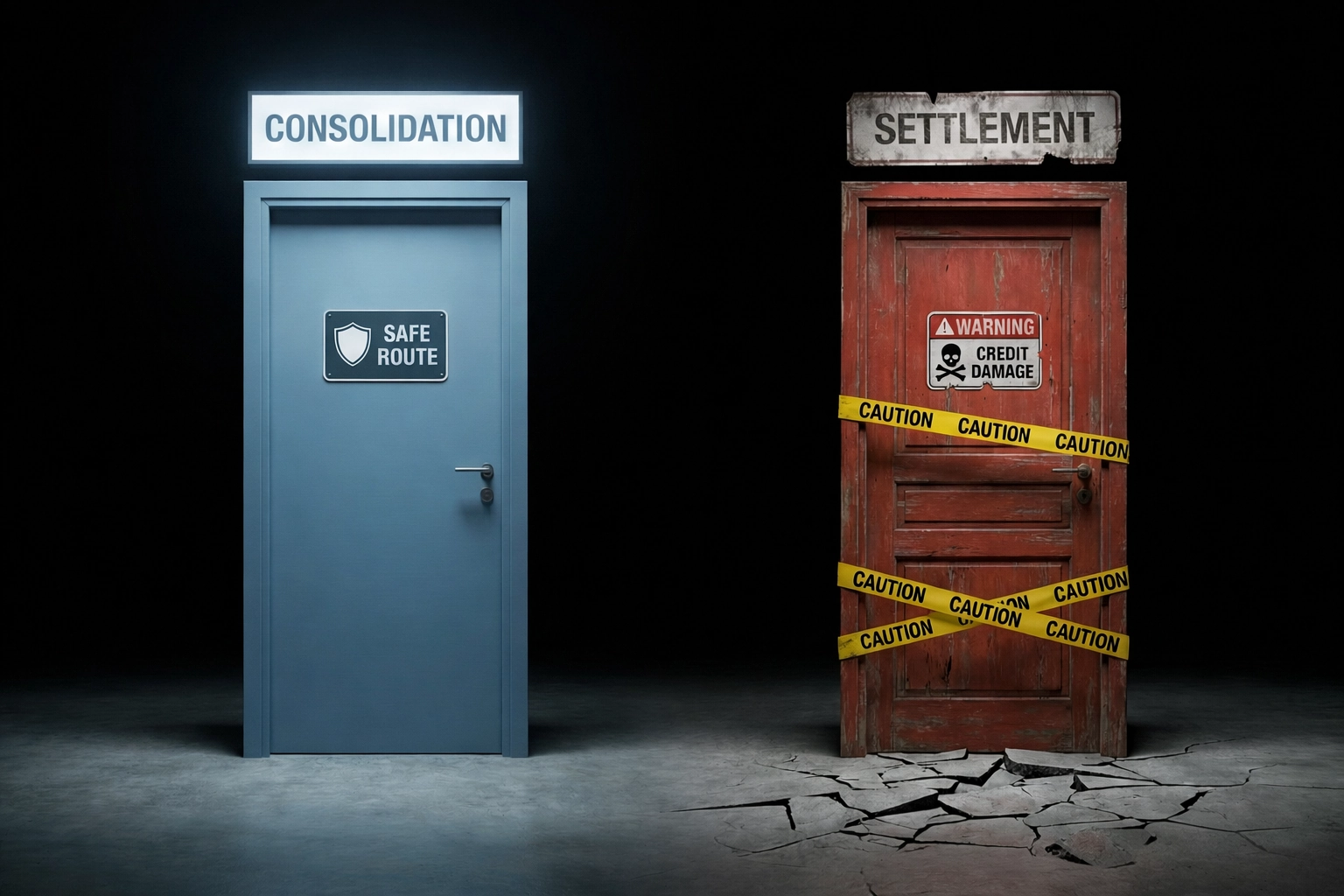
The Choice: Consolidation (Blue) is a safe path that keeps your financial house standing. Settlement (Red) is a damaged path—you might pay less, but you walk through ruin to get there.
Image Source: bestmoneytip.com
1. The Definition: Are You Paying or Defaulting?
The confusion comes because both are marketed as “Debt Relief.” But the mechanics are opposite.
- What is it? Taking out one big loan (at 10%) to pay off five small credit cards (at 25%).
- Do you pay it all? YES. You pay 100% of the principal + interest.
- Credit Impact: Neutral or Positive (Lowers utilization).
- What is it? Telling creditors “I can’t pay.” Negotiating to pay a lump sum (e.g., $5k on a $10k debt).
- Do you pay it all? NO. You pay less than owed.
- Credit Impact: Disastrous. Accounts are marked “Settled for less than full balance.”
2. Visualizing the Credit Score Hit
Why does Settlement hurt so much? Because to get a bank to accept 50% payment, you must first prove you are broke. Settlement companies will instruct you to stop paying your bills for 3-6 months.
4. Side-by-Side Comparison
| Feature | Consolidation Loan | Debt Settlement |
|---|---|---|
| Monthly Payment | Fixed (Lower Rate) | Deposited to Escrow |
| Creditor Relationship | Good (Paid in Full) | Burned (Charge-off) |
| Legal Risk | None (if paid) | Lawsuit Risk |
| Time to Freedom | 2-5 Years | 2-4 Years |