Snowball vs Avalanche: Which Debt Payoff Method Fits You?

If you ask a mathematician how to pay off debt, they will scream “Avalanche!” because it saves the most money. If you ask a behaviorist, they will whisper “Snowball,” because it keeps you motivated. The “best” method isn’t just about interest rates; it’s about whether you are a robot or a human. Here is the brutal comparison between the two reigning champions of debt destruction.

BMT Financial Planning Team BMT Financial Planning Team · 📅 Mar 2026 · ⏱️ 5 min read · DEBT › STRATEGY
Avalanche
Math
Highest APR FirstSave
Snowball
Mind
Smallest Balance FirstWin
Hybrid
Smart
Kill 20%+ APR FirstRec
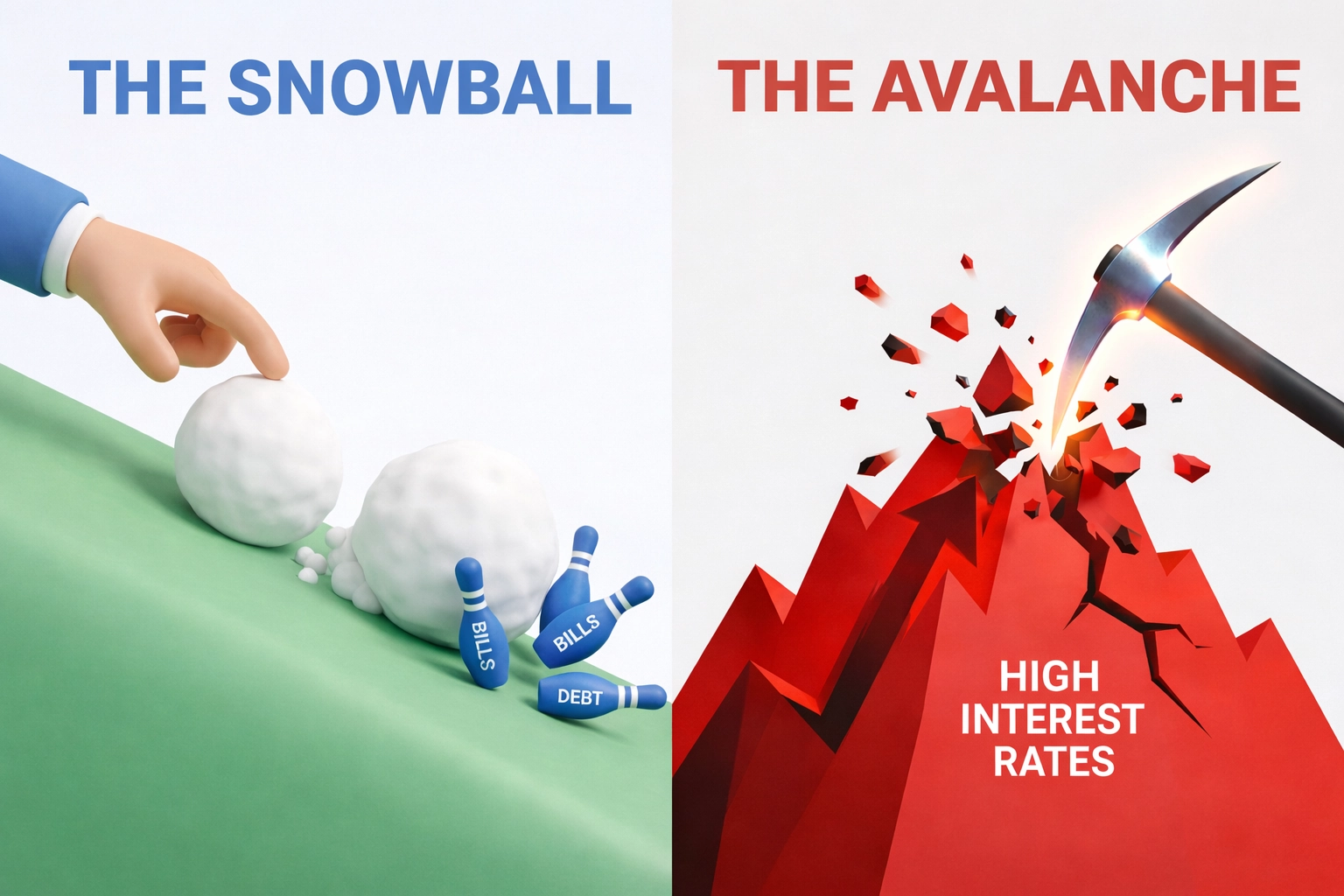
Split-screen comparison illustrating debt snowball (rolling a snowball) versus debt avalanche (breaking a high mountain peak with interest rates)

Psychology vs. Math: The Snowball builds momentum through small wins (Left), while the Avalanche attacks the steepest interest rates first (Right).

Image Source: bestmoneytip.com

1. The Debt Snowball: The Momentum Machine

Popularized by Dave Ramsey, this method ignores interest rates entirely. You list debts from Smallest Balance to Largest Balance.

The Algorithm:
1. Pay minimums on everything.
2. Throw every extra dollar at the smallest debt ($500 Visa).
3. When it’s gone, take that payment and roll it into the next smallest.
4. Repeat until the massive Student Loan is dead.
Why it works
Dopamine. Killing a small debt in month 1 feels amazing. That “win” gives you the energy to keep fighting for 2 years. It is behavioral modification, not math.

2. The Debt Avalanche: The Interest Killer

This is the mathematically correct way to get out of debt. You list debts from Highest Interest Rate (APR) to Lowest.

The Algorithm:
1. Pay minimums on everything.
2. Throw every extra dollar at the highest APR debt (29% Store Card).
3. Ignore the $5,000 balance at 3%; it doesn’t hurt you as much.
4. You save thousands in interest over time.
The Downside
It feels slow. If your highest interest debt is also your largest balance (e.g., $15k Credit Card), you might go 12 months without seeing a single account hit $0. Many people quit before the finish line.

3. Simulation: Which Saves More Money?

Let’s assume you have $20,000 in total debt. Here is the outcome.

TOTAL INTEREST PAID (LOWER IS BETTER)
Snowball Method $4,200 Paid in Interest
Avalanche Method $3,100 Paid in Interest
*Avalanche saves ~$1,100 in this scenario.

4. The Trader’s Hybrid Strategy

Don’t be a slave to one system. Use logic.

Step 1: Toxic Waste (Avalanche)
Identify any debt with APR > 20%. This is a financial emergency. Kill this first, regardless of balance size. It is burning your wealth.
Step 2: Clean Up (Snowball)
Once the toxic debts are gone, switch to Snowball. Knock out the small remaining balances (medical bills, small loans) to simplify your life and reduce monthly payments.

5. Frequently Asked Questions

Should I consolidate instead?
Maybe. If you can get a consolidation loan at 10% to pay off credit cards at 25%, do it. But cut up the cards immediately. If you run up the cards again, you will have double the debt (Loan + New Card Balance).
What about 0% Balance Transfers?
This is an Avalanche on steroids. It pauses the interest rate to 0%. It’s highly effective IF you pay it off within the promo period (usually 12-18 months).