Selling Your House? Here’s How Much Cash You’ll Actually Keep
Congratulations, you accepted an offer for $500,000! You are mentally spending that half-million dollars already. Stop. You are forgetting your “Silent Partners.” The Real Estate Agent wants their cut. The Title Company needs their fee. The County wants transfer taxes. And your Mortgage Lender wants their money back immediately. The check you receive at the closing table is often 10% to 40% less than the sales price. Here is the brutal math of the “Net Proceeds” calculation so you don’t get shocked at the closing table.

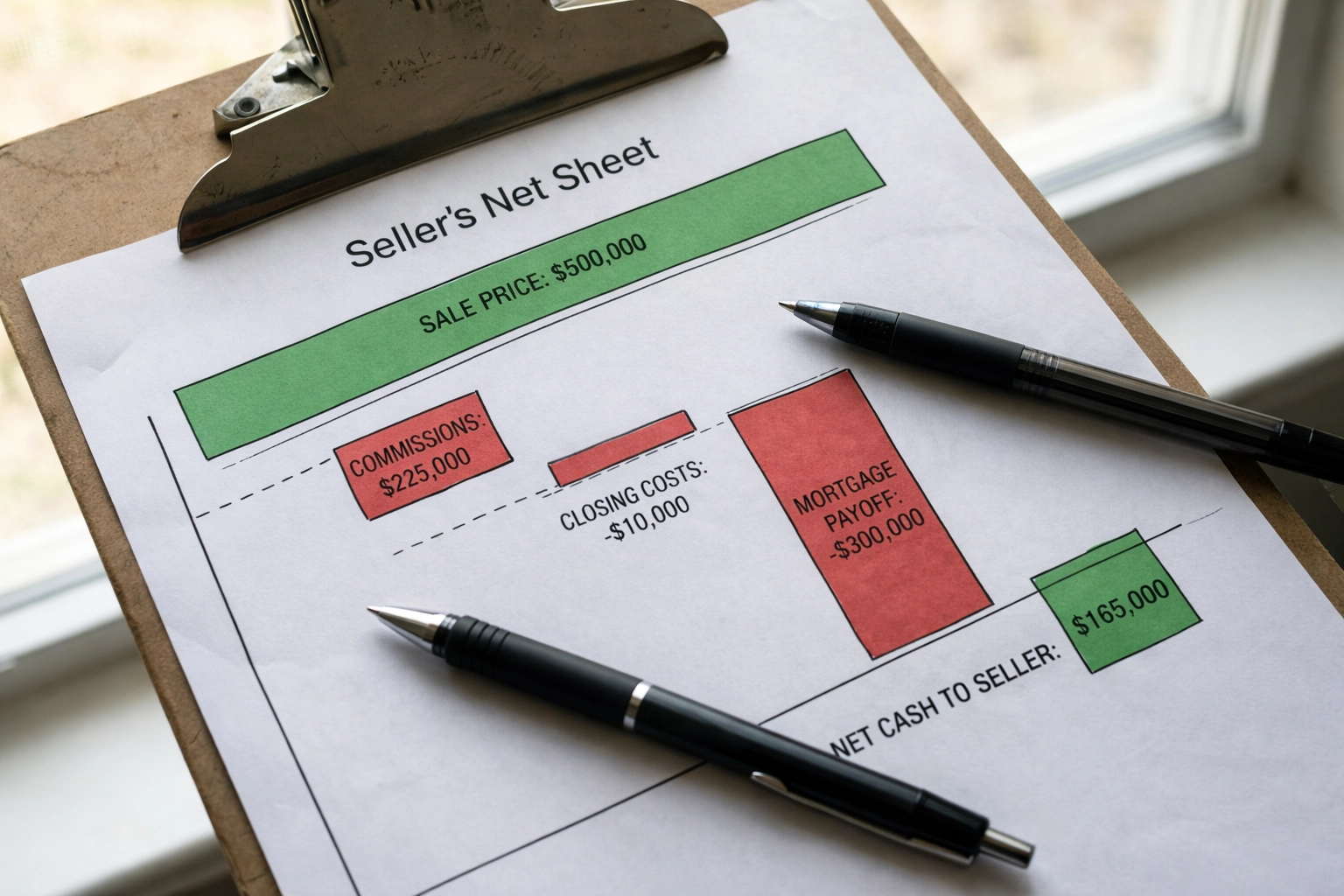
The Waterfall Effect: Sale Price at the top, costs biting chunks out in the middle, and actual Net Cash at the bottom.
Image Source: bestmoneytip.com
1. The Waterfall: Where Does the Money Go?
Let’s visualize where the money actually goes on a $500,000 Sale.
| Line Item | Estimated Cost | Description |
|---|---|---|
| Sale Price | $500,000 | The number on the contract. |
| (-) Mortgage Payoff | -$300,000 | Principal + Interest to date. |
| (-) Agent Commissions (6%) | -$30,000 | 3% to your agent, 3% to buyer’s agent. |
| (-) Closing Costs (2%) | -$10,000 | Title insurance, transfer tax, recording fees. |
| (-) Repairs / Concessions | -$5,000 | Credits given to buyer after inspection. |
| = NET PROCEEDS | $155,000 | The actual check you get. |
*Note: You sold for $500k, but you only “see” $155k. The rest vanished into debt and fees.
2. The Elephant in the Room: Agent Commissions
This is typically your largest single expense.
- How it works: Traditionally, the Seller pays BOTH agents. If the total fee is 6%, the Listing Agent keeps 3% and gives 3% to the Buyer’s Agent.
- Is it negotiable? YES. By law, commissions are not fixed. You can negotiate 5% or even 4%, but be careful—if you offer too little to the Buyer’s Agent, they might be less motivated to show your home.
- FSBO (For Sale By Owner): You can save the 3% listing fee by selling it yourself, but you usually still have to pay the Buyer’s Agent 3%.
3. What Are “Closing Costs” for Sellers?
Buyers pay for the loan; Sellers pay for the transfer.
- Title Insurance (Owner’s Policy): Protects the buyer from past liens. (Seller usually pays this).
- Transfer Tax / Stamps: A tax charged by the City/County to update the deed. (Can be $1 per $1,000 or much higher).
- Recording Fees: ~$100 to file paperwork.
- Prorated Property Tax: You owe property tax for the days you lived there this year up to the closing date.
4. Wait, What About Income Tax?
After you pay all the fees, do you have to pay IRS taxes on that $155,000 check?
Probably NOT, thanks to the “Section 121 Exclusion.”
As we covered in Article 507, if you lived there for 2 years, the first $250k (Single) or $500k (Married) of profit is tax-free.
Exception: If you flipped the house in under a year, you owe Short-Term Capital Gains tax (which is expensive).