Revocable vs Irrevocable Trust: Which Is Right for You?
In the world of trusts, you cannot have your cake and eat it too. You must choose between Control and Protection. A Revocable Trust gives you total control: you can change it, cancel it, or spend the money. But because you control it, your creditors can seize it. An Irrevocable Trust is a locked vault: once assets go in, you generally can’t get them back. But because you don’t own it anymore, neither do your creditors (or the nursing home). 95% of people need the first one. Here is how to know if you are in the 5% who need the second.

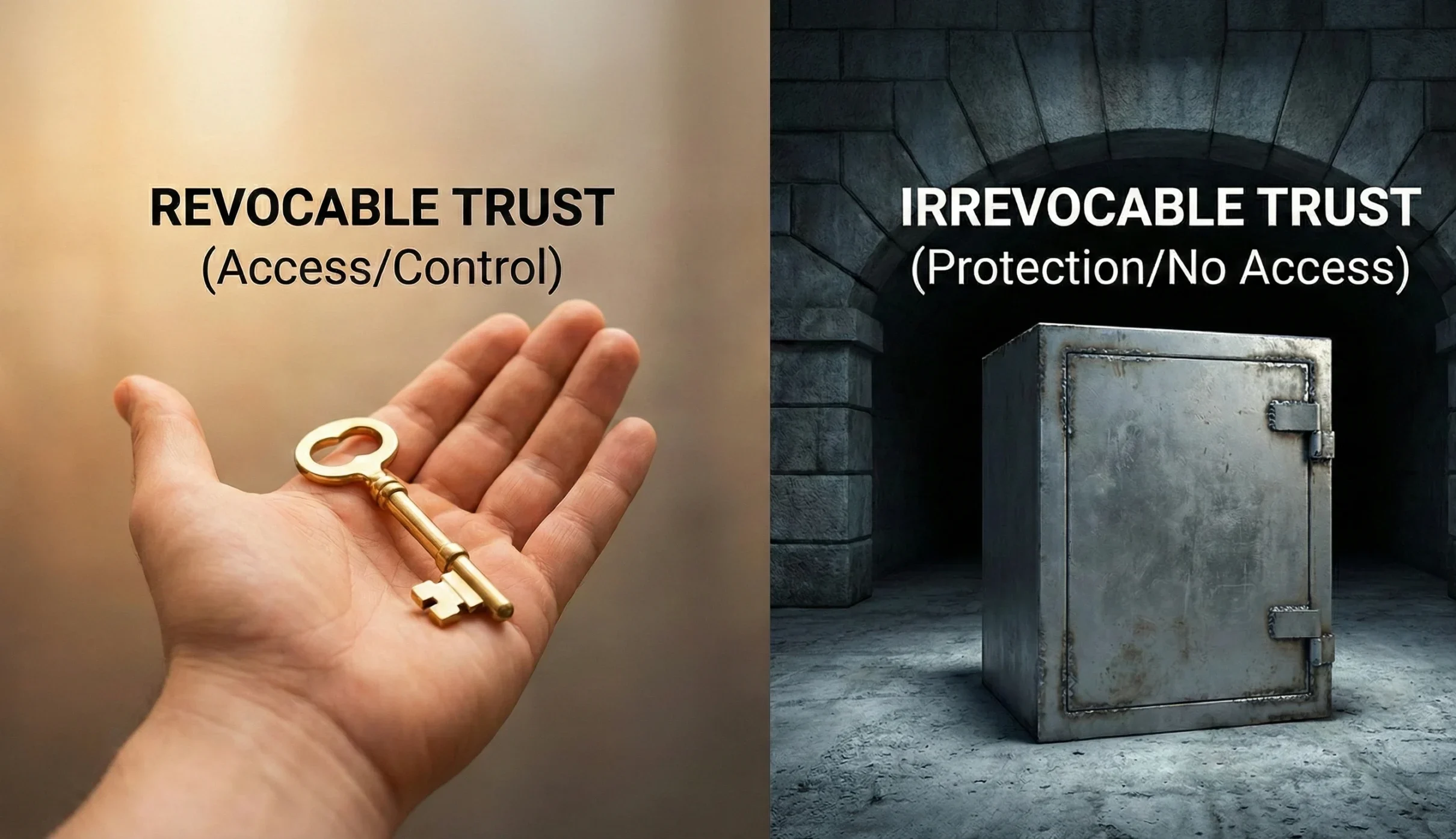
The Trade-Off: Revocable Trusts give you the key (Control), while Irrevocable Trusts weld the door shut (Protection).
Image Source: bestmoneytip.com
1. The Core Difference: Who Holds the Strings?
It all comes down to one question: Can you take the money back?
- Status: Like a pocket in your jacket.
- Mechanism: You move money to the Trust, but you are the Trustee. You can spend it, sell it, or dissolve the trust anytime.
- Tax ID: Uses your Social Security Number (SSN).
- Status: Like a steel vault you threw the key away for.
- Mechanism: You move money in, but you usually cannot be the Trustee. You must ask the Trustee for distributions (and they can say no).
- Tax ID: Needs its own Tax ID (EIN). It files its own tax return.
2. Comparison Table: What Do You Get?
Notice that both avoid probate, but only one protects from lawsuits.
| Feature | Revocable (RLT) | Irrevocable (ILT) |
|---|---|---|
| Avoids Probate? | YES | YES |
| Change Beneficiaries? | Anytime | Very Difficult |
| Asset Protection | NO (0%) | YES (High) |
| Medicaid Shield | NO | YES (After 5 Years) |
| Estate Tax Reduction | NO | YES |
3. The Main Use Case for Irrevocable: Medicaid
Why would anyone give up control? To qualify for government aid.
But to qualify for Medicaid, you must be “poor” (assets < $2,000).
The Strategy: You move your house and savings into an Irrevocable Trust. Since you don’t “own” them anymore, Medicaid can’t count them.
The Catch: There is a 5-Year Look-Back Period. You must do this 5 years before you get sick.
4. Which One Should You Choose?
Don’t overcomplicate it. Follow the standard path unless you have specific threats.
🏆 The Default: Revocable Trust
For 95% of families, the goal is simply “Make it easy for my kids when I die.” A Revocable Trust does this perfectly without changing your lifestyle.
⚠️ The Specialist: Irrevocable Trust
- Doctors/Architects: High risk of malpractice lawsuits.
- The Ultra-Wealthy: Net worth over $26M (couple) trying to avoid 40% Estate Tax.
- Elderly Planning: Healthy 65-year-olds planning for future nursing home costs.