15-Year vs 30-Year Mortgage: Lower Payment or Lower Interest?
Ask your grandfather, and he will say, “Pay off the house ASAP! Debt is the devil.” Ask a Wall Street trader, and he will ask, “What is the cost of capital?” The battle between the 15-Year and 30-Year mortgage isn’t just about interest rates; it is a battle of philosophies: Guaranteed Savings vs. Maximum Cash Flow. While the 15-year loan saves you massive amounts of interest, the 30-year loan gives you the flexibility to weather storms and invest elsewhere. Here is the mathematical breakdown of which lever you should pull.

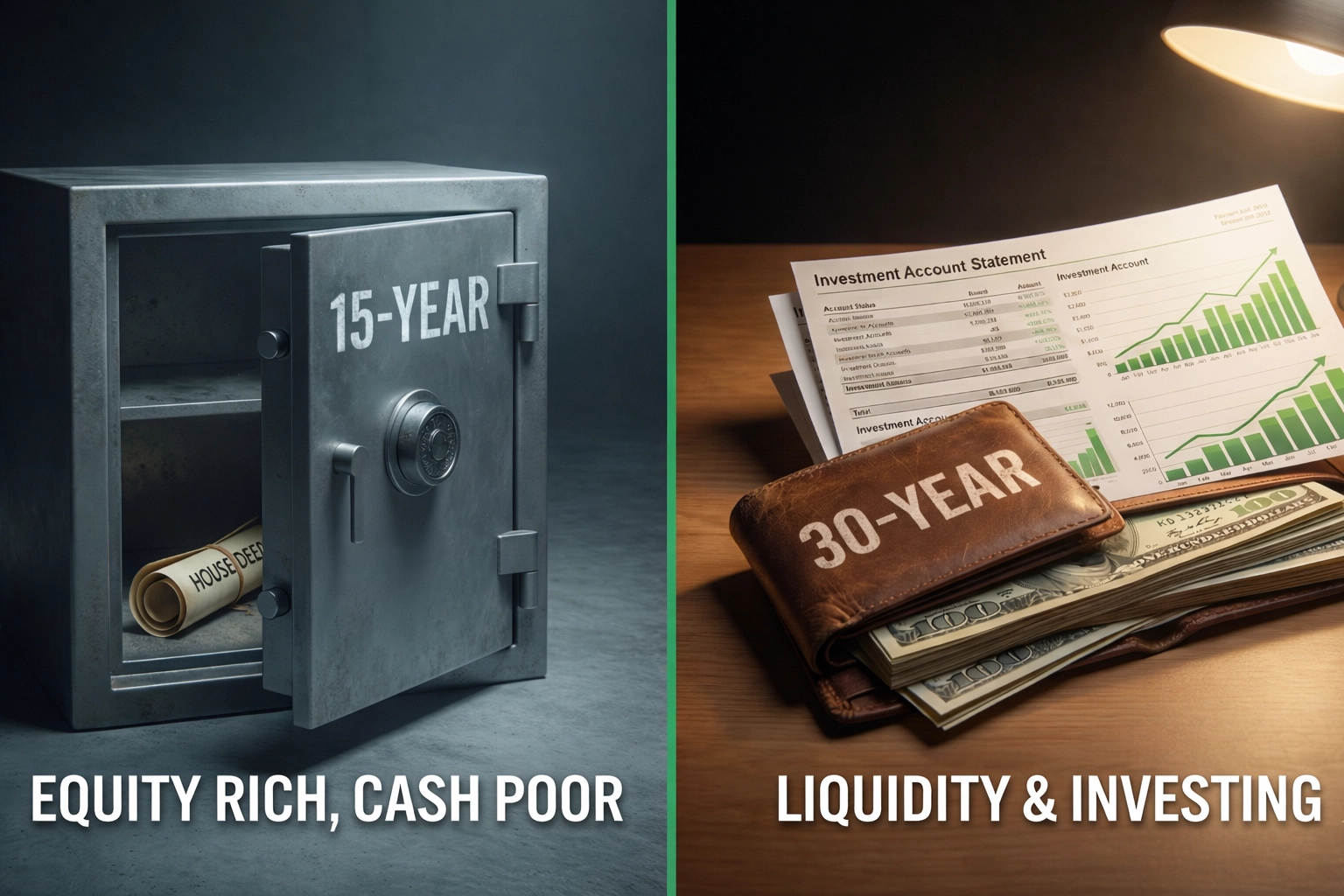
The Trade-Off: The 15-Year Mortgage locks your money in a safe (High Equity, Low Liquidity), while the 30-Year keeps cash in your wallet for investing or emergencies (High Liquidity).
Image Source: bestmoneytip.com
1. The Tale of the Tape: The Raw Numbers
Let’s compare a $400,000 Loan at typical market spreads (2026 Est: 6.0% for 30yr vs 5.5% for 15yr).
| Metric | 30-Year Fixed (6.0%) | 15-Year Fixed (5.5%) | Difference |
|---|---|---|---|
| Monthly P&I | $2,398 | $3,268 | +$870 / mo |
| Total Interest Paid | $463,000 | $188,000 | -$275,000 |
| Equity at Year 5 | $28,000 | $105,000 | +$77,000 |
*The 15-year saves you a Lamborghini in interest, but costs you a monthly car payment in cash flow.
2. The Bull Case for 15-Year: “Forced Wealth”
This is the Dave Ramsey approach. It is mathematically rigid but behaviorally sound.
- Interest Destroyer: You pay less than half the total interest.
- Rate Discount: Banks usually offer rates 0.5% – 0.75% lower than 30-year loans.
- Forced Savings: You build equity aggressively. It prevents you from blowing that extra $870/month on lifestyle creep.
3. The Bull Case for 30-Year: “Liquidity is King”
This is the Investor approach. Opportunity Cost is the keyword here.
• Scenario A: You invest that $870 in the S&P 500 (Historical Avg 8-10%). Over 30 years, this could grow significantly (e.g., $1M – $1.8M).
• Scenario B: You pay 6% interest to the bank.
Result: Mathematically, earning >6% beats paying 6%.
⚠️ Risk Note: 8-10% is a historical average, not a guarantee. Real returns vary, and Capital Gains Tax + Inflation will reduce your actual profit. Investing always carries the risk of loss, while paying off debt is a guaranteed 5.5% return.
4. The Danger of the 15-Year (House Poor)
The biggest risk of a 15-year mortgage is becoming “House Poor.”
- Locked Cash: You might have $200k in equity, but you can’t buy groceries with equity. If you lose your job, the bank won’t care how much equity you have; they want the monthly payment.
- Higher Hurdle: A $3,268 payment is much harder to make during a recession than a $2,398 payment. The 30-year loan is a safer “survival” option.